
Dark social and private community hubs are quietly rewriting the rules of digital marketing, and if your brand is not paying attention, you are handing serious ground to your competitors. Here is a number that should stop you cold: 84% of all online content sharing happens through dark social channels like WhatsApp, Slack, and private DMs, meaning the overwhelming majority of word-of-mouth conversation about your business is happening completely off your radar. As a small business or scaling brand, that is not just a missed opportunity, it is a structural blind spot that costs you real revenue every single day.
Key Takeaways
| Question | Quick Answer |
|---|---|
| What is dark social? | Dark social refers to content shared through private, untraceable channels like direct messages, email, and encrypted apps, where standard analytics cannot track the source. |
| What is a private community hub? | A private community hub is a branded, gated digital space (Discord server, Circle community, Slack workspace, etc.) where a curated audience engages deeply with your brand and each other. |
| Why do private hubs outperform public social media? | Engagement rates in private communities hover near 50%, while public platforms deliver as little as 0.05%, making private hubs dramatically more efficient for retention and loyalty. |
| Which businesses benefit most from private community hubs? | Any brand looking for scaleable growth, from solo founders to enterprise teams, can benefit. The model works especially well for education-driven and service-based businesses. |
| Do I need a growth partner to build a private community? | Not always, but a growth partner can significantly accelerate results by connecting your community data to your broader business strategy from day one. |
| What are the best platforms for private community hubs in 2026? | Circle, Discord, Slack, Mighty Networks, and Geneva are the leading platforms in 2026, each suited for different audience types and business models. |
| How does dark social affect my marketing data? | Dark social traffic typically appears as “direct” traffic in your analytics, inflating that channel and making it nearly impossible to attribute conversions to their actual source without specific tools. |
What Are Dark Social and Private Community Hubs, and Why Do They Matter in 2026?
Dark social is not a new concept, but its dominance in 2026 is impossible to ignore. The term was first coined to describe any sharing that happens outside of publicly trackable links, including text messages, private DMs on Instagram or LinkedIn, WhatsApp threads, and even Slack channels inside companies.
Private community hubs take this one step further. Rather than passively accepting that conversations happen in the dark, smart brands are building those private spaces deliberately, designing curated environments where their most engaged customers, members, and advocates gather, share, and grow together.
These are not Facebook Groups left to decay. We are talking about intentionally designed digital ecosystems with onboarding flows, exclusive content, structured discussion threads, and a clear value proposition for every member who walks through the door.
For a small business that cannot outspend corporate competitors on paid ads, dark social and private community hubs offer something far more powerful: trust at scale. And trust, in 2026, is the real currency.
Why Dark Social and Private Community Hubs Crush Public Social Media for Engagement
Public social media platforms are rented land. You can spend thousands building an audience on Instagram or LinkedIn, and an algorithm change can cut your organic reach by 70% overnight. That is a risk no serious brand should accept.
Private community hubs give you an owned audience, a group of people who signed up specifically to hear from you and engage with others in your space. The difference in quality and depth of interaction is not marginal, it is enormous.
54% of Gen Z users in 2026 now prefer private digital communities over traditional public social media feeds. This is the generation entering its peak buying years, and they are actively choosing gated spaces over algorithmic noise.
This shift matters whether you are a solo consultant, a growing e-commerce brand, or a mid-market company looking to build scaleable growth systems that do not depend on rented platforms.
Did You Know?
Engagement rates in private online communities reach nearly 50%, compared to just 0.05% to 5% on public social media platforms.
Source: CX Today
The Best Platforms for Building Dark Social and Private Community Hubs in 2026
Choosing the right platform is one of the most important decisions you will make when building your private community hub. The wrong choice creates friction for your members and administrative headaches for your team.
Here is a breakdown of the leading options in 2026, each suited for different goals and audience types.
Circle
Best for: Coaches, course creators, and service brands who want a premium, clean community experience with tight integration into their existing LMS or digital product stack.
Circle is the platform we recommend most often for businesses that want a polished, branded experience without the noise of Discord’s gaming-heavy aesthetic. It supports spaces, live streams, paywalled content, and member directories, making it a full-stack community solution.
Discord
Best for: Brands with an active, younger audience that values real-time conversation, multimedia sharing, and layered access roles.
Discord has matured well beyond gaming in 2026. Brands in crypto, creative industries, tech, and education are running thriving private community hubs here. The channel-based structure gives you granular control over who sees what.
Slack
Best for: B2B companies, agencies, and professional networks where members expect a workplace-style communication environment.
Slack’s familiarity works in your favor for a B2B private community. Your members already use it for work, so the adoption barrier is low. The trade-off is cost: Slack can get expensive as your community scales.
Mighty Networks
Best for: Community builders who want a native mobile app experience, built-in course hosting, and a strong sense of branded identity.
Mighty Networks is a strong contender for brands that want to build a distinct, app-based ecosystem separate from the major social platforms. It is particularly well-suited for membership businesses and transformational program communities.
Geneva
Best for: Lifestyle brands, creators, and organizations targeting Gen Z with a clean, group-chat-first private community experience.
Geneva is one of the fastest-growing private community platforms in 2026, specifically because it meets younger audiences where they already operate: in conversational, low-friction digital spaces that feel more like messaging than forums.
Quick Comparison Table
| Platform | Best For | Starting Price (2026) | Mobile App |
|---|---|---|---|
| Circle | Creators, coaches, LMS users | ~$89/mo | Yes |
| Discord | Younger audiences, real-time brands | Free / Nitro options | Yes |
| Slack | B2B, professional communities | ~$8.75/user/mo | Yes |
| Mighty Networks | Membership, course communities | ~$41/mo | Yes |
| Geneva | Gen Z brands, lifestyle creators | Free | Yes |
How Small Businesses Can Win with Dark Social and Private Community Hubs
Here is the truth that most marketing consultants will not say out loud: dark social and private community hubs are actually a bigger opportunity for small businesses than they are for large enterprises.
Why? Because a small business can move faster, create more genuine relationships, and build a tightly curated private community that a massive corporate brand simply cannot replicate authentically.
The key is starting with clarity. Before you build a single channel or invite a single member, you need to answer three questions:
- What specific transformation or value does your community offer members?
- Who is your ideal member, and why would they show up consistently?
- How does your private community hub connect to your actual revenue model?
Without those answers, a private community is just an empty room with branding on the walls. With them, it becomes an engine for retention, referral, and real revenue.
The process we follow at Meta Phoenix mirrors how we approach all growth strategies: Consultation, Comprehensive Audit, Data Analysis, Competitor Research, and then a Customized Strategy. That same discipline applies to building private community hubs. You do not start by picking a platform. You start by understanding your audience and your growth objectives.
For small businesses serious about this, read our deep dive on how to scale a small business with the right infrastructure in place from the beginning.
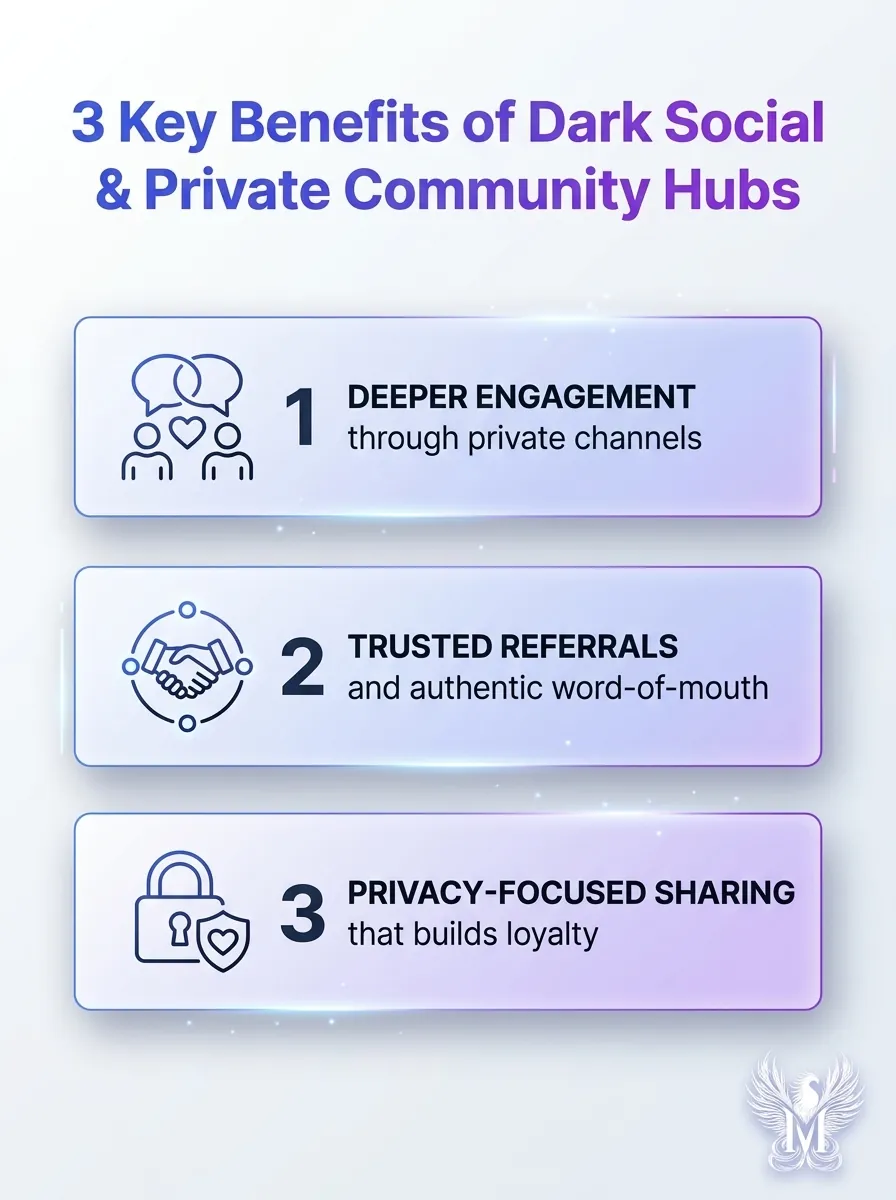
This infographic highlights three core benefits of dark social and private community hubs. It explains how these channels boost engagement and trust.
Dark Social and Private Community Hubs as Scaleable Growth Infrastructure
Most brands treat their community as a marketing add-on. The brands winning in 2026 treat their private community hub as core business infrastructure, as important as their CRM, their website, or their sales funnel.
That shift in thinking is what separates brands achieving scaleable growth from those constantly chasing cold traffic and watching ad costs erode their margins.
Here is how a mature private community hub drives scaleable, compounding returns:
- Retention infrastructure: Members who belong to your private community churn at dramatically lower rates because they have social investment in the space, not just in your product.
- Referral amplification: Dark social sharing within and around your community creates a referral loop that operates outside of any ad algorithm, and it is inherently trusted because it comes peer-to-peer.
- Product intelligence: Your private hub is a live focus group. Members tell you exactly what they want, what frustrates them, and what they would pay more for, if you have built a culture where they feel safe to share.
- Content leverage: The discussions, wins, and questions inside your community are a goldmine for content creation across every other channel you operate.
- Premium upsell pathways: Tiered community access (free tier, paid tier, VIP tier) creates a natural upgrade path that converts existing members into higher-LTV customers.
This is not theoretical. 18% of organizations in 2026 report that over 30% of their total company revenue is directly influenced by their branded online community. That number will only grow as more businesses formalize their private community hub strategy.
How a Growth Partner Helps You Build and Leverage Private Community Hubs
Building a dark social and private community hub is not complicated. Building one that actually works as a business asset requires strategic thinking that most businesses do not have the bandwidth to apply internally.
This is where the concept of a growth partner becomes genuinely valuable. A growth partner does not just hand you a platform recommendation and walk away. They help you design the community architecture, define the member journey, create the content strategy that keeps people active, and connect your community data to your broader sales and retention systems.
At Meta Phoenix, we approach private community strategy the same way we approach every engagement: through our five-step process of Consultation, Comprehensive Audit, Data Analysis, Competitor Research, and Customized Strategy. We do not guess at what will work for your audience. We find out, and then we build it with you.
If you want to understand what working with a dedicated growth partner actually looks like in practice, this article breaks it down clearly: what is a growth partner and how does the model work.
“We don’t just tell you what you need to do. We roll up our sleeves and build it alongside you, from strategy through execution.”
The most critical thing a growth partner does in this space is solve the integration problem. Over 70% of companies have not yet connected their CRM with their private community data. That gap means you are making decisions about your best customers without half the data that matters. We close that gap.
Measuring Success Inside Dark Social and Private Community Hubs
One of the great paradoxes of dark social and private community hubs is that the channels built around privacy and intimacy are actually more measurable than public social media, once you set up the right internal tracking.
Here are the metrics that actually tell you whether your private community hub is delivering business value:
- Active member rate: What percentage of your total members engaged at least once in the past 30 days? Anything above 30% is healthy for most communities.
- Post-to-member ratio: Are your members creating conversations, or just consuming? A strong community sees members initiating discussions, not just reacting.
- Revenue attribution: Are community members converting to paid products, upgrading tiers, or referring new paying customers at a measurably higher rate than non-members?
- Churn differential: Compare the churn rate of community members versus non-members. The gap is one of the most compelling internal arguments for investing in your private hub.
- Dark social link tracking: Use UTM parameters on all links shared inside your community and trackable short links to reduce the “direct traffic” attribution problem and see which community conversations are driving traffic and conversions.
- NPS and sentiment data: Private communities are an ideal environment to run Net Promoter Score surveys and gather qualitative feedback that never appears in public reviews.
Did You Know?
Customers spend 19% more after joining a brand’s private online community compared to those who only interact on third-party sites like Facebook.
Source: Bettermode 2026
Common Mistakes Brands Make with Dark Social and Private Community Hubs
Most brands that fail with private community hubs do not fail because the strategy is wrong. They fail because of avoidable execution mistakes. Here are the most common ones we see, and how to sidestep them.
Mistake 1: Launching Too Broad
A private community built for “everyone who likes our brand” has no clear value proposition and attracts nobody in particular. The most successful private community hubs in 2026 are built for a highly specific audience segment with a tightly defined promise.
Mistake 2: Skipping the Onboarding Experience
Most member drop-off happens in the first seven days. If you do not have a deliberate onboarding sequence that guides new members to their first meaningful interaction, you will watch your community slowly empty out regardless of how many people you recruit into it.
Mistake 3: Treating the Community as a Broadcast Channel
If every post in your private hub is a promotional announcement or content push, members will disengage fast. Private community hubs thrive when members feel the space belongs to them, not just to the brand that created it.
Mistake 4: Ignoring Dark Social Attribution
Not setting up proper tracking from day one means you will never be able to prove the ROI of your community to internal stakeholders or investors. This is one of the first things we address with every client we work with.
Mistake 5: Building Without a Revenue Connection
A community that does not have a clear path to revenue is a charity project. Before you launch, map out exactly how your private community hub connects to paid tiers, product sales, upsell pathways, or customer retention metrics that reduce churn costs.
Dark Social and Private Community Hubs: Which Is Best for Your Business Type?
Not every private community hub is built the same way, and the right approach depends heavily on your business model, your audience, and where you are in your growth journey.
| Business Type | Recommended Approach | Best Platform |
|---|---|---|
| Coach / Consultant | Paid membership community tied to program | Circle or Mighty Networks |
| E-commerce Brand | VIP customer hub for reviews, drops, and feedback | Discord or Geneva |
| B2B Agency / Firm | Client-facing Slack workspace with resource library | Slack |
| SaaS / Tech Product | Power user community for feedback loops and peer support | Circle or Slack |
| Creator / Media Brand | Fan and subscriber inner circle with exclusive content | Geneva or Discord |
| Education / LMS Brand | Student community integrated with course platform | Mighty Networks or Circle |
Conclusion
Dark social and private community hubs are not a trend to observe from a distance. In 2026, they are one of the most powerful, underutilized assets available to any brand that is serious about building durable, scaleable growth that does not depend on algorithm luck or ad spend.
The data is unambiguous: private community members engage at radically higher rates, spend more, churn less, and refer more often than audiences on public platforms. And the 84% of all content that flows through dark social channels every day represents a massive pool of organic word-of-mouth that most brands are not capturing at all.
Whether you are a small business building your first private hub or a scaling brand ready to formalize your community infrastructure, the path forward starts with strategy, not platform selection. Get the architecture right, connect it to your revenue model, and then choose the tools that serve your specific audience.
We work with businesses at every stage of this journey, from the very first consultation through full community build-out and ongoing optimization. If you want to build a private community hub that actually moves your numbers, you need a growth partner who has done it before and can connect every piece to your broader business goals.
Start by understanding the frameworks we use: learn how to scale a small business with the right foundation, and explore what a growth partner actually does at each stage of your ascent. The conversation is free. Staying stuck is not.
Frequently Asked Questions
Dark social refers to content shared through private, untrackable channels like WhatsApp, direct messages, SMS, and email. It affects your marketing by making a massive portion of your word-of-mouth referrals invisible to standard analytics, causing them to show up as “direct traffic” with no clear source attribution.
They are closely related but not identical. Dark social is any sharing that happens in private, untraceable channels. Private community hubs are deliberate, branded spaces a business builds to capture and amplify that private conversation. Building a private hub gives you a structured environment to benefit from the trust and intimacy of dark social, rather than just watching it happen invisibly.
For most small businesses starting out, Circle or Mighty Networks offer the best balance of ease of use, branding control, and monetization options. If your audience skews younger (Gen Z), Geneva or Discord are strong alternatives. The right platform depends on your audience and your revenue model more than any other factor.
The most direct ROI metrics are churn rate differential (do community members stay longer than non-members?), revenue per member versus non-member, and referral rates. You should also track active member rate and use UTM-tagged links to capture dark social traffic that flows from your community to your website and product pages.
Yes, and in some ways it is more impactful at that stage. A smaller, tighter private community hub is actually easier to make highly active and genuinely valuable. Starting with your top 50 to 100 customers and building a premium inner circle is a proven approach that creates intense loyalty before you scale wider.
Dark social is the natural distribution layer that forms around a strong private community hub. When you build a space that delivers real value, members share content, recommendations, and links inside their own private networks, creating compounding, algorithm-independent growth. For any brand pursuing scaleable growth, this organic dark social amplification is one of the highest-leverage channels available.
You can absolutely launch one yourself, but the most common outcome for self-managed communities is low engagement and eventual abandonment. A growth partner brings the strategic frameworks, community architecture experience, and revenue integration expertise that turn a private hub from a nice experiment into a real business asset. The investment pays for itself when members stay longer and spend more.