
The top strategies for building emotional connections with customers are no longer a “nice to have” for growing businesses — they are the foundation of sustainable revenue. Customers who form an emotional relationship with a brand have a 306% higher lifetime value than those who are merely satisfied, which means every customer you connect with emotionally is worth three times more to your business over time.
For any small business trying to compete in 2026, that number changes everything. This guide covers the strategies that actually work, grounded in how real businesses build loyalty that lasts.
Key Takeaways
| Question | Answer |
|---|---|
| Why does emotional connection matter more than satisfaction? | Emotionally connected customers spend more, stay longer, and refer more often — satisfaction is a baseline, emotional connection is the multiplier. |
| What is the first step to building emotional connections with customers? | Start by understanding who your customer actually is beyond their purchase — their fears, goals, and values — not just their demographics. |
| Can a small business compete emotionally with large brands? | Yes — and often more effectively. Small businesses have a structural advantage: direct relationships, personal communication, and the ability to respond faster. |
| How does a growth partner help build emotional loyalty systems? | A growth partner builds the infrastructure — CRM flows, automation, content strategy — that makes emotional connection consistent and scalable rather than ad hoc. |
| Is automation the enemy of emotional connection? | Not if it is used correctly. Automation handles timing and consistency; the message itself still needs to feel human and personal. |
| What role does trust play in emotional connection? | Trust is the prerequisite. Without it, emotional connection cannot form — 81% of consumers must trust a brand before they even consider buying. |
| How do emotional connection strategies support scaleable growth? | They reduce churn, increase referrals, and raise lifetime value simultaneously — which means growth costs less per customer as the business scales. |
Why the Top Strategies for Building Emotional Connections with Customers Redefine Business Growth
Most businesses focus almost entirely on acquisition — getting more leads, running more ads, closing more deals. The problem is that acquisition without retention is an expensive treadmill.
When customers feel an emotional bond with your brand, they do not shop around at the first price difference. They stay, spend more, and bring others with them. That shift from transactional to relational is what separates businesses that grind for growth from those that build it systematically.
For a small business operating without massive marketing budgets, this distinction is critical. The math of emotional loyalty makes every marketing dollar work harder.
Did You Know?
71% of consumers report that an emotional connection to a brand influences their loyalty more than price or convenience.
Source: Edelman Trust Barometer
That 71% figure tells you something important: price alone is not your competition. When customers feel connected, they choose you even when a cheaper option exists.
This is the ultimate protective advantage for a growing brand — and it is one of the core reasons a structured growth partner relationship prioritizes systems that build loyalty alongside systems that generate leads.
Strategy 1: Know Your Customer Beyond the Purchase (Build Emotional Connections with Customers Through Understanding)
The most foundational of all the top strategies for building emotional connections with customers is deceptively simple: actually know who your customer is.
Not just their age bracket or zip code. Their anxieties, their aspirations, what they talk about with people they trust, and what they wish a business in your space would just understand.
- Run post-purchase surveys that ask about feelings and motivations, not just product ratings.
- Read your own reviews and highlight the emotional language customers use naturally.
- Talk to your best customers directly — a 20-minute conversation reveals more than months of analytics.
- Build customer personas that include values and fears, not just demographics.
- Track patterns in repeat buyers — what do they have in common beyond buying behavior?
When you understand what your customers actually care about emotionally, your messaging, your offers, and your follow-up all become far more resonant. This is not guesswork — it is structured intelligence gathering.
Strategy 2: Build Trust Before You Ask for the Sale
In 2026, 81% of consumers must trust a brand before they will even consider making an initial purchase. Trust is not something customers extend automatically — it is earned through consistent, transparent, and helpful behavior before any transaction takes place.
For a small business, building pre-purchase trust is one of the highest-leverage activities possible. Every piece of educational content, every honest answer to a customer question, and every clear explanation of what you do and do not offer contributes to a trust account that makes conversion far less effortful.
“Most businesses don’t struggle because of lack of effort — they struggle because there’s no clear starting point.” — Meta Phoenix, Phoenix Ascent Framework
Trust-building actions that work in practice include:
- Publishing helpful, honest content on your website that answers real customer questions.
- Being transparent about pricing — no hidden surprises at checkout or in proposals.
- Responding to reviews, including negative ones, with care and accountability.
- Sharing your values and process openly so customers know what to expect.
- Following up after a sale with no agenda other than making sure the customer is happy.
The businesses that understand how to scale a small business sustainably know that trust is infrastructure — not optional, and not a one-time action.
Strategy 3: Use Consistent, Human Communication to Strengthen Emotional Connections with Customers
Consistency is where most businesses fall short. They have a strong first impression — a great website, a smooth sales call, a good product — and then the experience becomes inconsistent or impersonal as the relationship continues.
Emotional connection requires a steady rhythm of meaningful touchpoints. Not promotional blasts, but genuine communication that makes customers feel seen and valued.
Consider the following touchpoints that carry emotional weight:
- Post-purchase check-ins — a simple message asking if the customer is happy creates disproportionate goodwill.
- Milestone acknowledgments — recognizing anniversaries, birthdays, or “one year as a customer” moments.
- Personal replies to feedback — not template responses, but messages that reference the specific thing the customer mentioned.
- Value-first newsletters — content that teaches, not just sells.
- Proactive problem resolution — reaching out before the customer has to complain.
Critically, 86% of consumers say that human interaction is moderately or very important to their brand experience, even as AI adoption grows. Automation should handle the timing and delivery of communication — the message itself must still feel human.
A structured CRM, set up as part of a proper growth infrastructure, makes this kind of consistent human communication scalable without losing its personal quality.
Strategy 4: Respond to Mistakes with Accountability and Care
One of the most underutilized strategies for building emotional connections with customers is how you handle things when they go wrong.
Every business makes mistakes. Shipments are delayed, services fall short of expectations, communication breaks down. What separates brands that lose customers over these moments from those that actually gain loyalty through them is the response.
Customers who feel genuinely cared for after a problem experience something called a “service recovery paradox” — their emotional connection to the brand can actually increase beyond what it was before the issue occurred.
Practical accountability looks like this:
- Acknowledge the issue quickly and directly — do not make the customer wait or feel unheard.
- Take full responsibility — avoid defensive language that minimizes the customer’s experience.
- Offer a resolution that goes slightly beyond expectations — a refund is a floor, not a ceiling.
- Follow up after the resolution to confirm the customer is satisfied.
Did You Know?
Emotionally connected customers are 11.1x more likely to advocate for a brand and 5.7x more likely to trust it after a mistake.
Source: Xebo.ai — Why Customer Experience Matters
That 11.1x advocacy multiplier is not abstract. It means that a customer who already feels emotionally connected and then experiences you handling a problem well becomes one of your most powerful marketing assets — at zero additional cost.
Strategy 5: Reward Emotional Milestones, Not Just Transactions (Build Scaleable Growth Through Loyalty)
Most loyalty programs are transactional: spend X dollars, earn Y points. They work to a degree, but they do not build emotional connection — they build habit.
The top strategies for building emotional connections with customers go a layer deeper. Loyalty programs that reward emotional milestones — like a customer’s anniversary with your brand, shared values, or meaningful personal occasions — see 2.5x higher engagement than point-based systems alone.
This approach reflects something important about how emotional loyalty works: people feel connected to brands that notice them as individuals, not just as transactions.
Examples of emotional milestone rewards:
- A personalized message and small offer on a customer’s one-year anniversary with your brand.
- Acknowledgment of a customer’s personal milestone (new business, new home, new baby) if they have shared it.
- Exclusive access or early offers tied to shared values — sustainability, community, local support.
- Recognition of long-term loyalty with non-discount rewards like priority service or personal access to your team.
For scaleable growth, these practices need to be systematized — not left to memory. A well-configured CRM can trigger these touchpoints automatically, making them consistent without requiring manual effort for every single customer interaction.
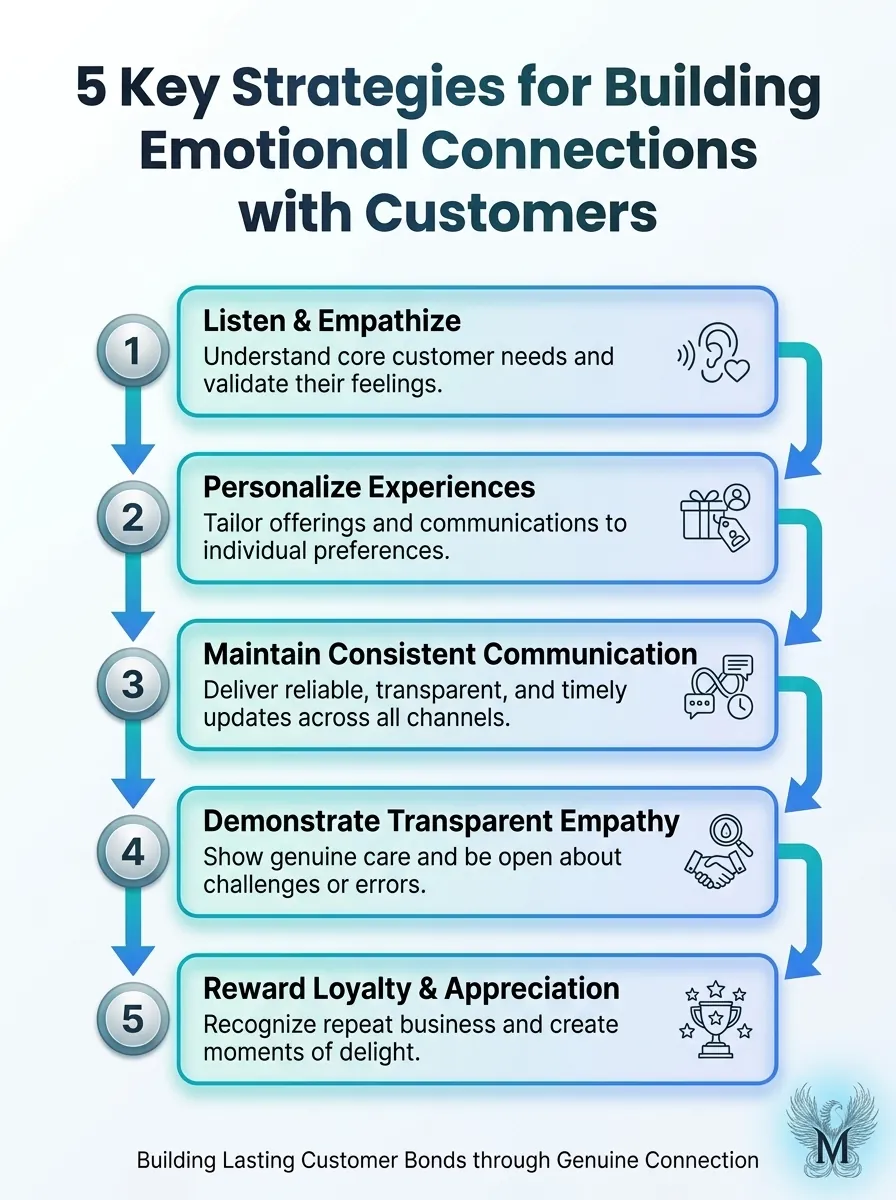
Five practical strategies to build stronger emotional connections with customers, with actionable tips to apply them.
Strategy 6: Show Customers You Value Them — Indifference is the Fastest Way to Lose Them
One of the most sobering data points in customer retention is this: 68% of customers who leave a brand do so because they feel the company is indifferent to them or does not appreciate them. Not because of a bad product. Not because of price. Because they felt ignored.
This means the single biggest threat to retention for most businesses is not competition — it is the slow erosion of feeling valued.
Building emotional connections with customers requires active, visible appreciation. This does not mean expensive gifts or over-the-top gestures. It means small, consistent actions that communicate: we see you, and we are glad you are here.
Practical appreciation signals include:
- Saying thank you in a way that feels specific and genuine, not template-driven.
- Remembering previous conversations or purchases and referencing them in follow-up.
- Proactively sharing resources or information that benefits the customer even when it does not directly lead to a sale.
- Inviting long-term customers to provide input on new products or services — making them feel like partners, not just buyers.
These touchpoints cost very little but accumulate into a strong emotional narrative: this brand actually cares about me.
How a Growth Partner Approach Supports Emotional Connection Strategies for Small Business
Most of the strategies described above require something that many small business owners simply do not have in abundance: consistent systems and time to execute them without dropping the ball.
This is precisely where the growth partner model becomes essential. A growth partner is not a vendor who delivers a one-time project and disappears — it is an ongoing strategic and operational relationship that builds the infrastructure behind your customer experience.
In practical terms, a growth partner helps you:
- Set up CRM systems that track customer milestones, preferences, and interaction history automatically.
- Build automation flows that trigger personal-feeling touchpoints at the right moment without manual effort.
- Create content strategies that communicate values and build trust before a customer ever reaches out.
- Design website experiences that feel human, clear, and aligned with what customers emotionally need to see before they trust you.
- Measure what matters — tracking retention rates, repeat purchase rates, and referral activity, not just new leads.
The Phoenix Ascent Framework, which guides Meta Phoenix’s approach to business growth, structures these capabilities into clear stages — from initial digital presence through to a full ongoing growth partner relationship where emotional loyalty systems are continuously refined and optimized.
Scaleable Growth Starts with Emotionally Connected Customers
There is a common misconception that scaleable growth is primarily about acquiring more customers faster. In reality, sustainable scale happens when the customers you already have stay longer, spend more, and bring others with them.
That dynamic is driven entirely by emotional connection. A business with a high emotional connection rate can grow its revenue significantly without proportionally increasing its marketing spend — because loyalty and advocacy are doing a large portion of the work for free.
For a small business working toward scaleable growth, this means the emotional connection strategies in this guide are not supplementary — they are core to the growth model itself.
Consider the compounding effect:
| Customer Type | Likelihood to Refer | Lifetime Value Impact | Growth Contribution |
|---|---|---|---|
| Satisfied but emotionally neutral | Low | Baseline | Minimal passive |
| Emotionally connected | 11.1x higher | 306% higher | Active advocacy and repeat spend |
The businesses that build scaleable growth in 2026 are not the ones spending the most on ads — they are the ones building the deepest relationships with the customers they already have.
Conclusion: Top Strategies for Building Emotional Connections with Customers Drive Everything
The top strategies for building emotional connections with customers are not separate from your growth strategy — they are your growth strategy. Every customer who moves from satisfied to emotionally connected becomes a higher-value, longer-retained, more referral-active asset for your business.
For a small business, the competitive advantage of emotional connection is enormous. Large brands struggle to feel personal. You do not have to. With the right systems in place — CRM infrastructure, consistent communication cadences, trust-first content, and milestone-based appreciation — you can build the kind of loyalty that makes scaleable growth a structural outcome rather than a hopeful accident.
A dedicated growth partner relationship is what makes these strategies consistent rather than sporadic. If you are ready to build the systems behind emotional loyalty and scale with structure, explore how the Phoenix Ascent Framework guides businesses through each stage of that journey at Meta Phoenix’s Growth Partner services.
Frequently Asked Questions
The most effective top strategies for building emotional connections with customers in 2026 include deep customer understanding, pre-purchase trust building, consistent human communication, meaningful milestone recognition, and accountable response to service failures. These strategies work together to move customers from transactional to relational — which is where the real growth happens.
Emotionally connected customers have a 306% higher lifetime value than satisfied but emotionally neutral customers, and they spend an average of $632 more annually. They are also 11.1x more likely to advocate for your brand, which drives referral revenue without additional marketing spend.
Yes — with the right systems. A small business can use CRM automation, milestone-triggered communication, and value-first content to deliver personal-feeling experiences at scale. The key is building infrastructure that makes consistency automatic rather than relying on manual effort.
A growth partner builds the backend systems — CRM setup, automation flows, content strategy, and measurement frameworks — that make emotional connection strategies consistent and scalable. Rather than executing one-off tactics, a growth partner ensures every stage of the customer experience reinforces emotional loyalty over time.
68% of customers who leave a brand do so because they feel the company is indifferent to them — not because of a bad product or a specific incident. This means the top strategy for retention is active, visible appreciation, not just avoiding mistakes.
Satisfaction is a baseline — the customer got what they paid for. Emotional connection means the customer feels understood, valued, and aligned with the brand’s values. Satisfaction keeps customers from leaving; emotional connection makes them stay, spend more, and refer others actively.
Start with the highest-leverage, lowest-cost actions: personalized post-purchase follow-up, honest and human communication, publicly responding to reviews with care, and creating educational content that helps your customers before they buy. These approaches cost primarily time and attention, not budget, and they build the trust foundation that emotional connection requires.