
If you’ve been struggling to grow your subscriber base, you’re not alone — and the right top lead magnet ideas to grow your email list can change everything almost overnight. Here’s a number that should stop you in your tracks: interactive tools like quizzes and calculators convert at upwards of 5.2%, nearly 6x higher than gated eBooks, which have now dropped below 0.9%. That gap tells you everything you need to know about where email list growth is heading in 2026. Whether you’re a small business just building your first funnel or you’re working with a growth partner to push toward scaleable growth, your lead magnet strategy is one of the highest-leverage decisions you’ll make.
Key Takeaways
Question |
Answer |
|---|---|
What is a lead magnet? |
A free offer you give in exchange for a visitor’s email address — anything from a checklist to a webinar. |
Which lead magnet converts best in 2026? |
Interactive formats like quizzes, calculators, and assessments consistently outperform passive downloads. |
How do lead magnets help small business growth? |
They build an owned audience you can nurture over time, reducing reliance on paid ads and social platforms. |
What makes a lead magnet offer irresistible? |
It solves one specific problem quickly and makes the value obvious before anyone hands over their email. |
How does a growth partner help with email list building? |
A growth partner builds and refines your lead capture systems, automates follow-up, and tracks list performance over time. |
How many fields should a sign-up form have? |
Using fewer than four fields produces roughly 10% conversion rates — significantly better than bare single-field forms. |
Can lead magnets support scaleable growth? |
Yes. When tied to an automated CRM and nurture sequence, a single lead magnet can generate leads continuously without ongoing effort. |
What Makes a Strong Lead Magnet for Small Business Email Growth
Before diving into the specific formats, it helps to understand what separates a lead magnet that builds your list from one that collects digital dust.
The core principle is simple: the offer has to solve one real problem for one specific person. Broad, generic offers produce broad, low-quality lists. Narrow, specific offers attract exactly the subscribers you want in your funnel.
For a small business, this is actually an advantage. You know your customers. You’ve sat across the table from them, answered their questions, and heard their frustrations. That knowledge is the raw material for a lead magnet that genuinely converts.
There are four qualities every high-converting lead magnet shares:
Immediate value — the subscriber gets something useful right away, not after a seven-email sequence
Specificity — it targets one clear outcome, not a general topic area
Low friction — it requires minimal effort to access and use
Clear relevance — it attracts people who would actually buy your product or service
When you design your lead magnet around these four qualities, your opt-in rate goes up and your subscriber quality improves at the same time.
Top Lead Magnet Ideas to Grow Your Email List: Checklists and Templates
Checklists and templates are two of the most reliable lead magnet ideas to grow your email list because they deliver immediate, practical value with almost no reading required.
A checklist answers the question, “What do I need to do?” A template answers, “How do I do it?” Both give subscribers something they can use today.
For a cleaning business, a “Pre-Move-Out Cleaning Checklist” is far more compelling than a general guide about cleaning. For a bookkeeper, a “Monthly Expense Review Template” is something a prospect will actually download and use every single month.

This infographic highlights five effective lead magnet ideas to grow your email list. Each idea includes a quick takeaway you can implement today.
The beauty of checklist-style lead magnets is the production time. A well-researched, genuinely useful checklist can be built in an afternoon and designed in a few hours.
Here are high-converting checklist and template ideas by business type:
Service businesses: “Pre-Appointment Checklist for [Your Service]”
Consultants: “Quarterly Business Review Template”
Coaches: “Weekly Habit Tracker Template”
Retailers: “Seasonal Buying Guide Checklist”
Contractors: “Project Scope Checklist Before You Hire Anyone”
Did You Know?
Short-form written content like checklists and templates is favored by 58.6% of marketers over long-form guides for higher opt-in performance.
This doesn’t mean long-form content has no place. It means that for your primary lead magnet, the shortcut wins. Save the depth for your email sequences and paid offers.
Interactive Lead Magnet Ideas to Grow Your Email List
Interactive lead magnets are the highest-converting format available in 2026. Quizzes, self-assessments, and calculators don’t just capture an email address — they deliver a personalized result that feels genuinely valuable to the individual taking it.
Consider the difference between downloading a generic guide versus completing a quiz that tells you exactly which stage of business growth you’re in and what to focus on next. The second experience is memorable and shareable. The first gets forgotten in a Downloads folder.
Types of interactive lead magnets that work particularly well:
Quiz-based assessments — “What Type of [Customer Problem] Do You Have?” style quizzes segment your list automatically based on responses
ROI or savings calculators — Let prospects see the potential value of your service in their own numbers
Diagnostic tools — “Is Your [Business Area] Healthy?” tools that score a current situation and suggest next steps
Product finders — Guide prospects to the right offer based on their specific answers
For a small business building toward scaleable growth, an assessment-style lead magnet has an added benefit: it tells you exactly who is in your audience and what they need. That data makes every follow-up email smarter.

Building an interactive lead magnet does require more upfront investment than a checklist, but the conversion performance often justifies it quickly. If you’re working with a structured plan to scale your small business, an interactive assessment can become a core part of your lead generation engine.
Webinars and Video-Based Lead Magnet Ideas
Webinars remain one of the most powerful lead magnet ideas to grow your email list when your offer involves any level of trust-building or complexity.
A well-run webinar accomplishes three things at once: it builds authority, qualifies prospects based on who shows up, and gives you a full hour of attention from people who are genuinely interested in what you do.
In 2026, webinar formats have expanded significantly. You don’t have to run a live event to benefit from this format:
On-demand webinars — Pre-recorded sessions that subscribers can watch immediately after opting in
Live Q&A workshops — Shorter, more intimate events (30-45 minutes) with audience interaction
Mini video courses — A three-to-five video series delivered over a week via email
Behind-the-scenes tours — Especially effective for service businesses showing how their process works
For higher-ticket services, webinars often outperform every other lead magnet format when it comes to lead quality. The people who invest 60 minutes of their time are serious about finding a solution.
“The goal isn’t to get the most subscribers. It’s to get the right subscribers who actually want what you sell.”
Free Tools, Swipe Files, and Resource Libraries
Sometimes the best lead magnet ideas to grow your email list aren’t content at all — they’re access.
Swipe files, resource libraries, and free tools give subscribers something they’ll bookmark and return to. That repeated value keeps your brand top of mind and creates natural opportunities for conversion over time.
Practical examples of resource-based lead magnets:
Swipe files — Collections of real examples subscribers can model (email subject lines, ad copy, pricing pages)
Script libraries — Ready-to-use word-for-word scripts for sales calls, customer service, or social posts
Tool stacks — Curated lists of the exact tools you use to run your business, with setup notes
Resource hubs — Members-only pages with downloadable assets that update regularly
Proposal or contract templates — High perceived value for B2B audiences
The key to making resource-based lead magnets work is curation. Don’t just compile a list of links — add your perspective, your recommendations, and your experience. That added layer is what makes it genuinely valuable.
For businesses that offer services, a well-structured resource library also positions you as the authority in your space before a prospect ever speaks to you. It does the trust-building work automatically, at any hour of the day.
Discount Offers, Free Trials, and Product Samples
For product-based businesses and subscription services, the most effective lead magnet is often the product itself — or a piece of it.
A well-placed discount or free trial offer converts visitors who are already close to buying but need one final push. These lead magnets are especially effective when combined with urgency and specificity.
Formats that work well in this category:
First-order discounts — “Get 15% off your first order when you join our list” is still highly effective for e-commerce
Free trials — Standard for software businesses but adaptable for service providers (a free first session, audit, or consultation)
Free samples — Physical product businesses can offer a low-cost sample in exchange for an email and a small commitment
Exclusive member pricing — Position the email list itself as the access point for deals subscribers can’t get anywhere else
The important distinction here is that this type of lead magnet attracts buyers, not just browsers. That makes the resulting list highly valuable from a revenue standpoint — even if the raw subscriber numbers are lower than a free download would generate.
How Lead Magnets Connect to Scaleable Growth Systems
A lead magnet on its own is just an opt-in mechanism. What turns it into a growth asset is the system behind it.
When a subscriber opts in, what happens next? If the answer is “they get an email and then nothing for a week,” you’re leaving revenue on the table. A structured follow-up sequence — built inside a CRM and triggered automatically — is what converts opt-ins into customers.
This is where most small business email lists stall out. The lead magnet works. The form converts. But without a connected system, those subscribers drift away before they ever become paying clients.
Building toward scaleable growth means connecting every part of your lead generation flow: the lead magnet, the capture form, the CRM, the automated nurture sequence, and the conversion offer. When those pieces work together, your email list becomes a revenue engine that runs continuously in the background.
Did You Know?
73% of consumers are willing to share personal data when they receive clear, immediate value in return — making the value of your offer more important than the ask.
That statistic is the core principle of sustainable list growth. Subscribers don’t withhold their email because they’re protective of their inbox. They withhold it because the offer doesn’t feel worth it. Get the value right, and the friction disappears.
The Role of a Growth Partner in Email List Strategy
Building a lead magnet is straightforward. Building a lead generation system that produces consistent, quality subscribers month after month is a different challenge entirely.
This is where working with a growth partner fundamentally changes the outcome. A growth partner doesn’t just help you create a lead magnet — they help you build the infrastructure around it, connect it to your broader business systems, and refine it based on real performance data.

Understanding what a growth partner actually does makes it clear why this relationship is so effective for email list growth specifically. The focus isn’t on isolated tactics — it’s on building systems that compound over time.
A growth partner approach to email list building typically looks like this:
Audit what’s already in place — identify gaps in the capture and follow-up flow
Design the right lead magnet — based on your specific audience, offer, and conversion goal
Build the capture infrastructure — forms, landing pages, CRM connections, and tagging
Launch the nurture sequence — automated emails that move subscribers toward a purchase decision
Track and refine — monitor opt-in rates, open rates, and conversion rates monthly
For a small business that doesn’t have a dedicated marketing team, this kind of structured support is the difference between a stagnant list and one that grows predictably month over month.
The Phoenix Ascent Framework: A Structured Approach to Lead Generation and Scaleable Growth
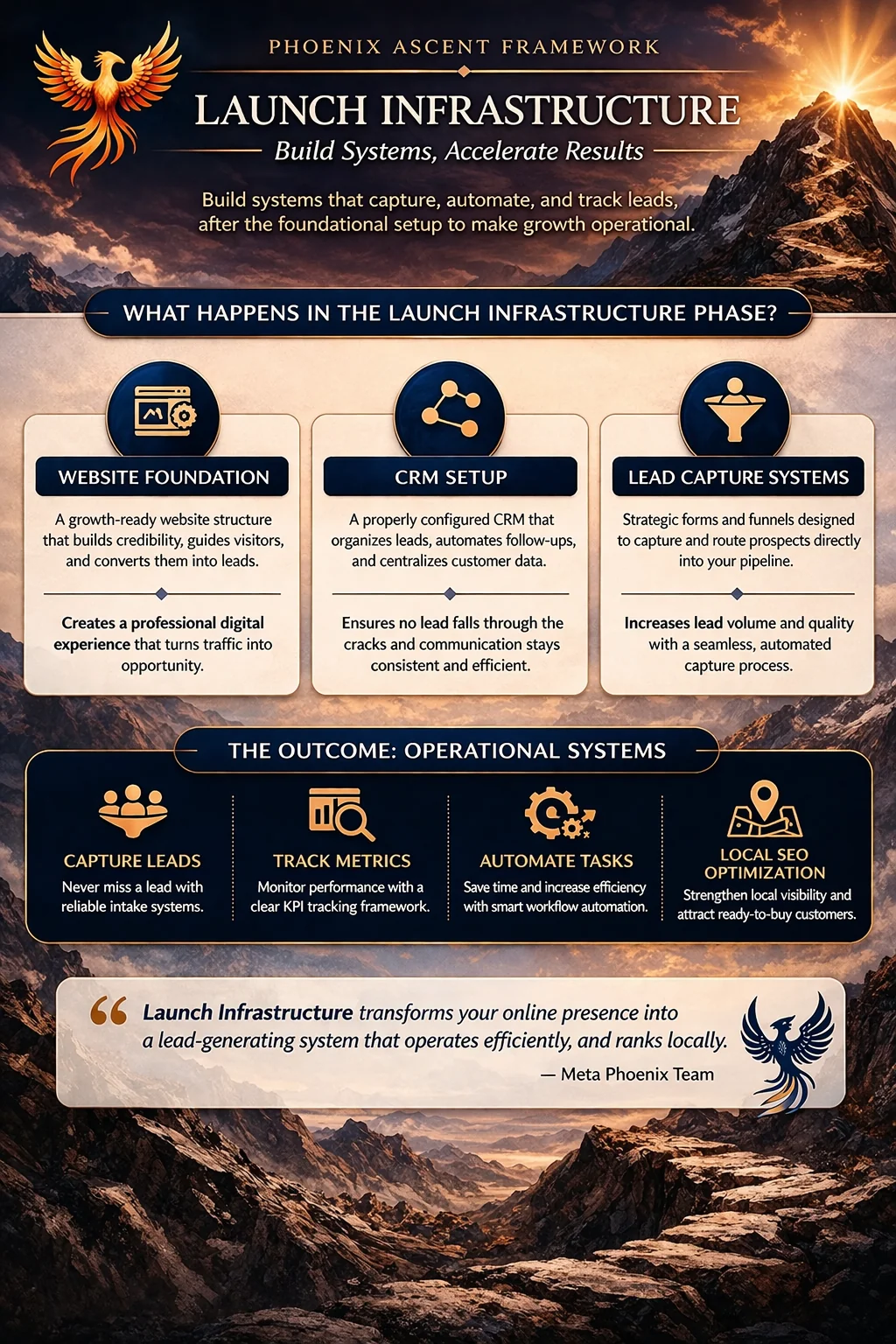
At Meta Phoenix, our approach to email list growth sits inside a broader framework for building businesses that grow with intention. The Phoenix Ascent Framework is a four-stage path that takes a small business from digital presence all the way to scaleable growth as a fully connected system.

Here’s how each stage relates to lead magnet and email list strategy:
Stage |
Focus |
Lead Magnet Role |
Investment |
|---|---|---|---|
Digital Launch |
Build your online presence |
Basic lead capture setup on website |
$1,500 - $3,000 |
Launch Infrastructure |
Connect systems and capture |
CRM integration, forms, lead flows |
$3,500 - $8,000 |
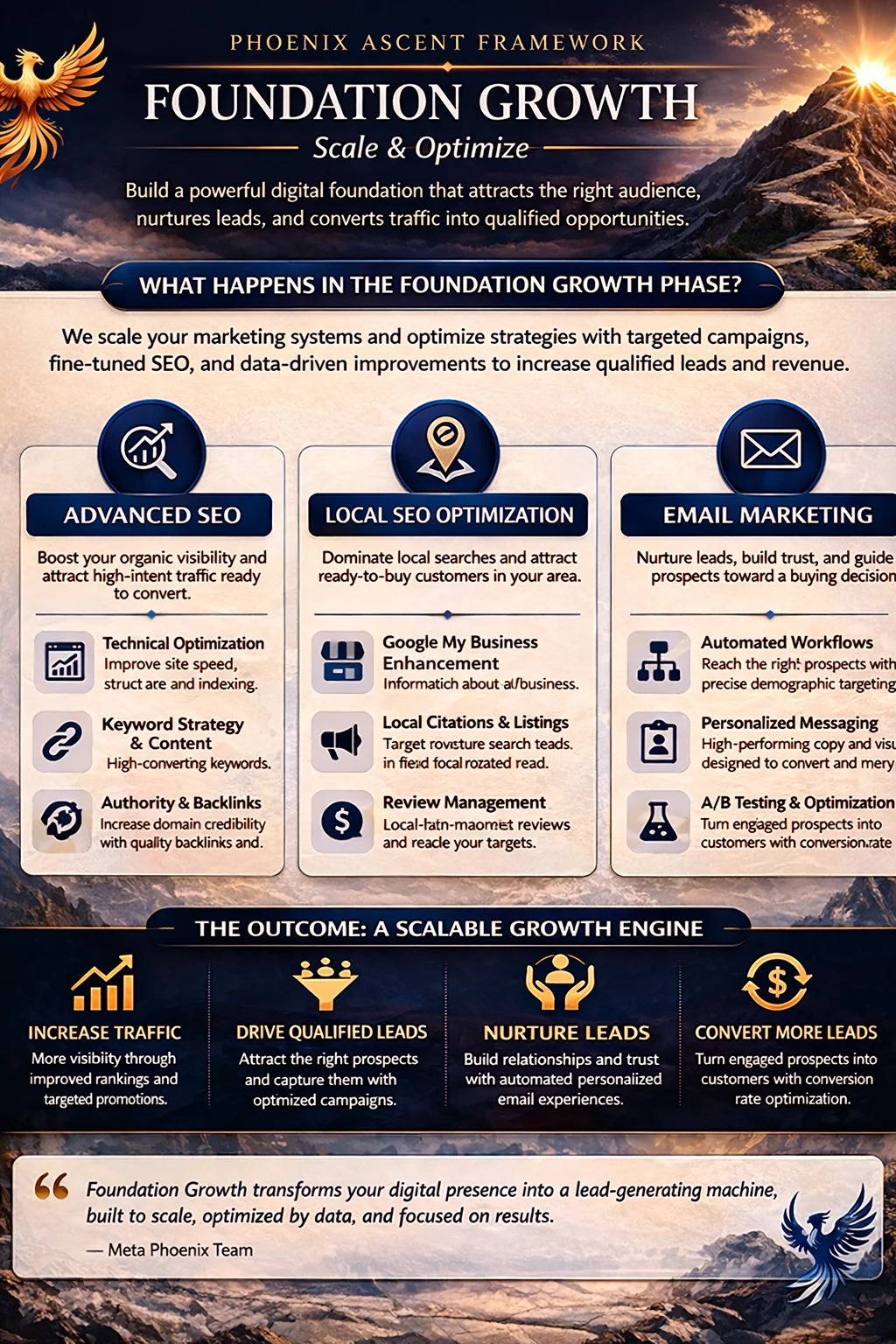
Foundation Growth |
Activate and refine systems |
Email campaigns and nurture sequences |
$1,500/month |
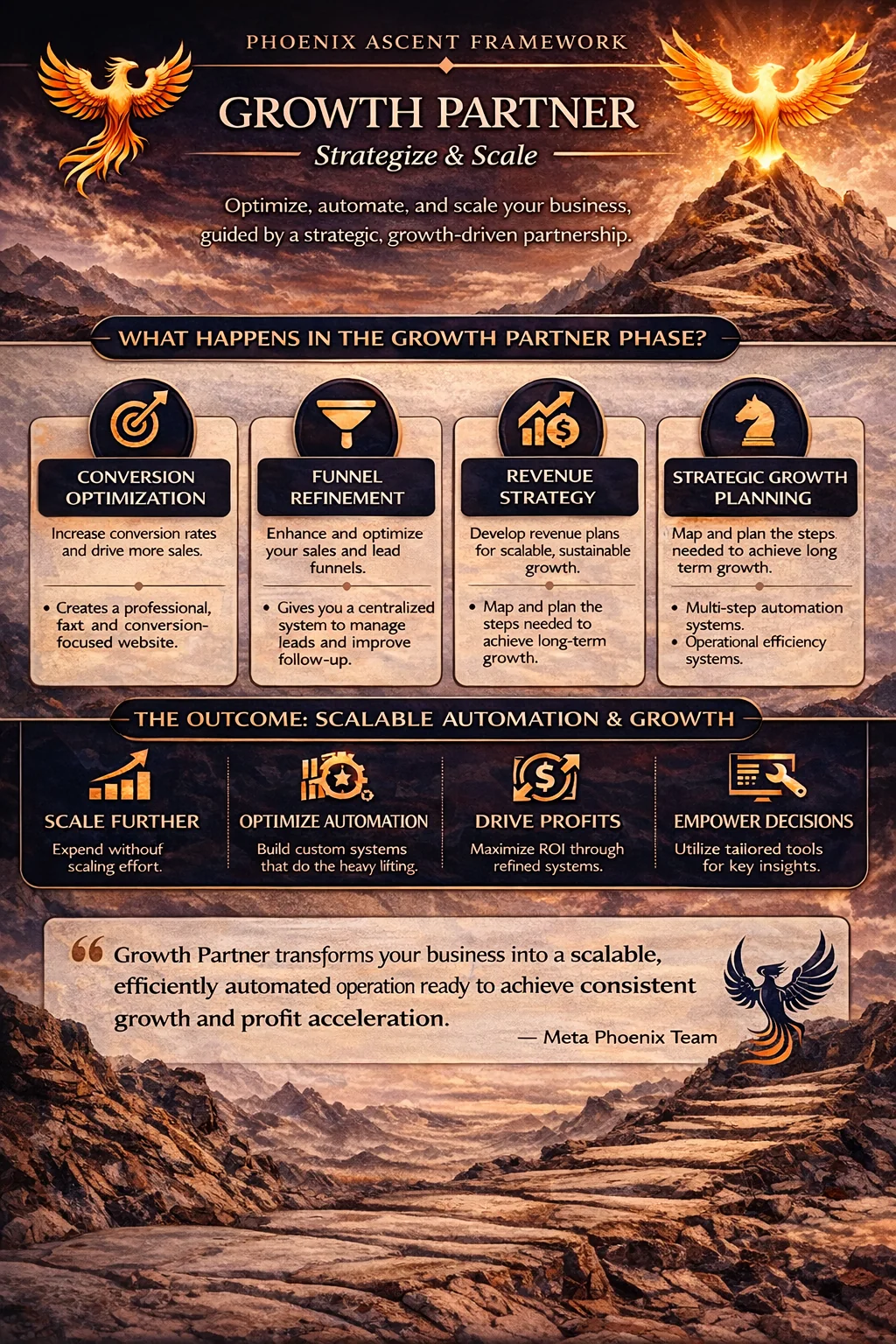
Growth Partner |
Scale and optimize |
Full list monetization and automation |
$2,000/month+ |
Most businesses we work with start by identifying their current stage and building the right lead magnet for where they actually are. There’s no point in building a sophisticated quiz funnel if your CRM isn’t set up to receive the leads properly.
The growth path framework makes this decision straightforward. You don’t need to figure out where to start — the framework maps you to the right stage based on where your business actually is today.
Best Practices for Lead Magnet Delivery and Form Optimization
Getting your lead magnet idea right is half the job. Getting your delivery and form setup right is the other half.
Here are the practical best practices that make a real difference in opt-in performance in 2026:
Keep your form short but not empty — two to three fields (name, email, and one qualifier) consistently outperforms single-field forms
Use a dedicated landing page — removing navigation and other distractions increases conversion rates significantly
Deliver instantly — redirect to a download page immediately on opt-in, and follow up with an email confirmation within minutes
Name your lead magnet specifically — “The 7-Point Client Onboarding Checklist” converts better than “Free Checklist”
Make the thank-you page do work — use it to introduce your next step, whether that’s booking a call or exploring a service page
Tag subscribers by lead magnet — this enables smarter segmentation in your email follow-up sequence
Test one thing at a time — headline, button text, or form length each deserve individual testing before drawing conclusions
These mechanics might seem minor but they compound quickly across the lifetime of your list.
Conclusion: Put the Right Lead Magnet Ideas to Work for Your Email List Growth
The top lead magnet ideas to grow your email list in 2026 range from simple checklists and templates to interactive quizzes, webinar registrations, and free tools. The right choice depends on your audience, your offer, and the stage of growth your business is at right now.
What every effective lead magnet has in common is this: it delivers specific, immediate value to one clear type of person. When that condition is met, opt-in rates rise, subscriber quality improves, and your email list becomes an actual business asset rather than a vanity metric.
For a small business working toward scaleable growth, the lead magnet is just the entry point. The real opportunity is in what happens after someone subscribes — the automated follow-up, the CRM tracking, and the structured nurture system that converts subscribers into paying clients over time.
If you’re ready to build a lead generation system that goes beyond a single form, working with a growth partner who understands how all the pieces connect is the most efficient path forward. You can learn more about building consistent growth momentum through structured, stage-based support — and start where you actually are, not where you think you should be.
Frequently Asked Questions
The fastest-growing lead magnets right now are interactive formats like quizzes and assessments, followed by specific checklists and templates. These convert because they deliver immediate, personalized value rather than generic information. Choose the format that best fits your audience’s most pressing problem.
eBook opt-in rates have dropped significantly and now sit below 0.9% in many industries, compared to interactive tools that can hit 5%+. eBooks can still work when the topic is highly specific and the audience is motivated enough to read a longer format. For most small businesses in 2026, shorter and more interactive formats will outperform them.
Two to four fields consistently produces the best results — typically name, email, and one qualifying question. Single-field forms can feel lower quality to prospects, while forms with five or more fields create noticeable drop-off. Test your specific audience, but starting with three fields is a reliable baseline.
Your form should feed directly into your CRM using a native integration or a tool like Zapier, tagging each subscriber by which lead magnet they opted in through. From there, an automated welcome sequence should trigger immediately. This is a core part of what the Launch Infrastructure stage in a structured growth program addresses.
For service-based businesses, assessment or diagnostic tools work extremely well because they show potential clients their specific situation and naturally position your service as the solution. Checklists and free consultation offers are also strong performers because they attract people already close to making a buying decision.
A growth partner reviews your full lead generation flow — not just the lead magnet itself — and identifies gaps in your capture form, CRM setup, and nurture sequence. They track performance data and refine the system over time so your email list grows more predictably. It’s a different approach from hiring someone to build a single asset and walk away.
Most well-positioned lead magnets show meaningful opt-in data within the first 30 days, giving you enough information to assess performance and make adjustments. Conversion from subscriber to customer depends heavily on your nurture sequence and the quality of the traffic reaching your form. A structured three-month engagement is generally the minimum timeframe needed to refine the full system and see consistent results.