
A well-built multimedia and content marketing strategy is one of the most direct paths a small business has to building authority, generating leads, and sustaining growth. And the numbers are stark: 78% of people prefer watching a short video to learn about a product, compared to just 9% who prefer reading text. If your content mix is still text-heavy in 2026, you are actively working against the way the majority of your market wants to buy.
Key Takeaways
| Question | Answer |
|---|---|
| What is a multimedia and content marketing strategy? | It is a documented plan that combines video, audio, written, and interactive content across multiple channels to attract, nurture, and convert your target audience. |
| Why do small businesses need a structured content strategy? | Without structure, content efforts are inconsistent and unmeasurable. A documented plan ties every piece of content to a business outcome, making scaleable growth achievable. |
| Which content formats perform best in 2026? | Short-form video, interactive content, email with embedded video, and podcast audio are the top-performing formats by engagement and conversion this year. |
| How does a growth partner help with content strategy? | A growth partner embeds into your business to align content with revenue goals, manage distribution systems, and optimize performance over time. |
| What is the Phoenix Ascent Framework? | It is a four-stage growth system designed to move small businesses from digital foundation through to full-scale, measurable growth with structured content and marketing systems. |
| How much does a content marketing strategy cost? | Depending on your stage, structured programs start from $1,500 for a Digital Launch through to $2,000/month and above for a full Growth Partner engagement. |
| Can I scale content marketing without a large team? | Yes. AI-driven tools, automation, and a structured framework allow small teams to produce and distribute high-quality multimedia content at scale. |
What Makes a Strong Multimedia and Content Marketing Strategy?
A strong multimedia and content marketing strategy is not about producing more content. It is about producing the right content, in the right format, for the right stage of your customer’s journey.
In 2026, the businesses that win with content are the ones that combine multiple formats intentionally, rather than posting sporadically across channels and hoping something sticks.
The core ingredients of an effective strategy include:
- A documented plan tied to specific business outcomes
- A defined audience profile with clear pain points and content preferences
- A multi-format mix that includes video, audio, written, and interactive content
- A structured distribution system across owned, earned, and paid channels
- A measurement framework that tracks content performance against revenue goals
For a small business, building this from scratch without a guiding framework is where most content efforts stall. That is exactly why a structured approach, like the one we outline through the Phoenix Ascent Framework, matters so much.
The Four Content Formats Driving the Best Results in 2026
Not all content formats perform equally. In 2026, the data points clearly to four formats that dominate engagement and conversion for businesses at any stage of growth.
1. Short-Form Video
Short-form videos under 60 seconds generate 2.5 times more engagement than long-form videos. For a small business working with limited production resources, this means a 30-second clip produced on a smartphone can outperform a heavily produced two-minute brand film.
2. Interactive Content
Quizzes, calculators, and assessments yield twice the engagement of static articles. Interactive content moves your audience from passive reader to active participant, which is a critical shift for identifying high-intent prospects in your multimedia and content marketing strategy.
3. Email With Video
Video content embedded in email campaigns drives a 300% boost in click-through rates. Email remains one of the highest-ROI channels available to any business, and pairing it with video amplifies what you already own.
4. Podcast and Audio Content
Podcast ads deliver a 28% higher brand recall rate than traditional display or standard video ads. For B2B and high-consideration purchases, audio content builds the kind of trust that accelerates longer sales cycles.
Did You Know?
Companies with a documented content strategy see 33% higher ROI than those operating with an informal approach. Structure is not a nice-to-have, it is the entire point.
How the Phoenix Ascent Framework Shapes Your Multimedia and Content Marketing Strategy
The Phoenix Ascent Framework is a four-stage growth system built specifically for small businesses that need structure, not guesswork. Each stage maps directly to where you are now and what your multimedia and content marketing strategy needs to look like at that point.
Rather than treating content as a standalone activity, the framework integrates it with your systems, infrastructure, and business goals. This is what separates businesses that grow consistently from those that plateau.

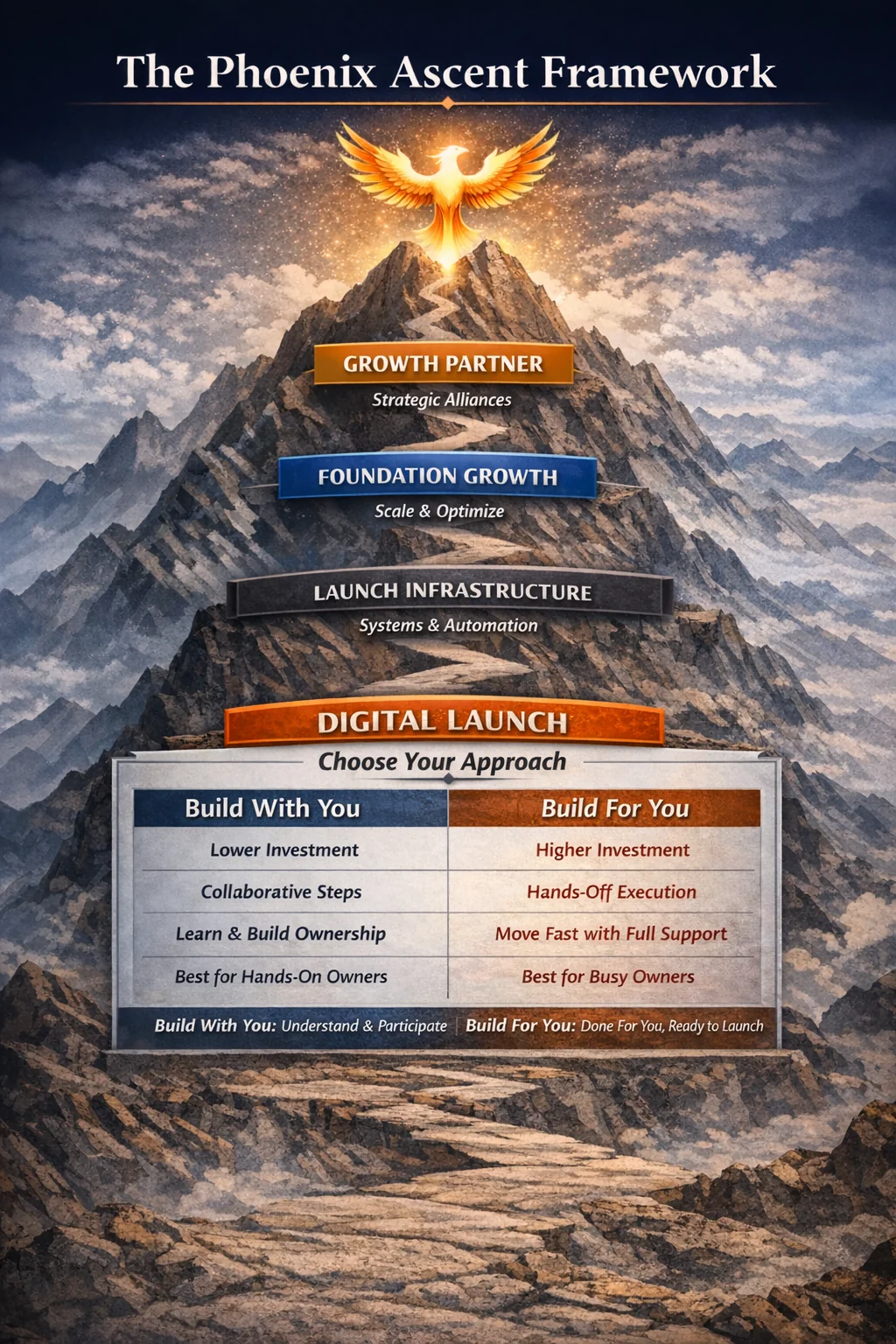
To understand the full scope of what this framework means for your business, read our detailed breakdown of what a growth partner actually does and how the relationship differs from a traditional agency engagement.
Best Multimedia and Content Marketing Strategy by Growth Stage
Your content strategy should match where your business is right now. Here is how we approach it across each stage of the framework.
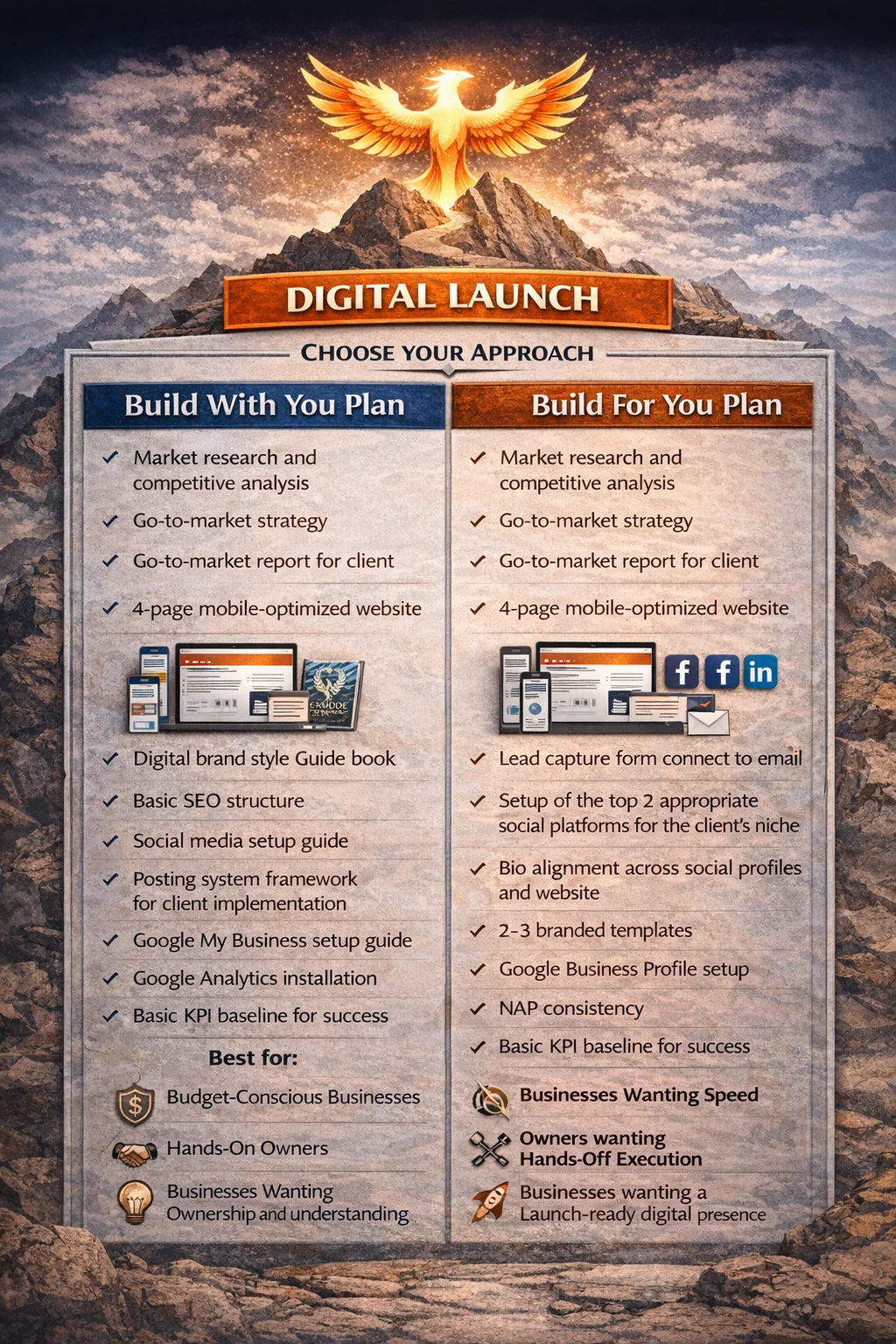
Stage 1: Digital Launch (Best for Businesses Starting from Scratch)
At Stage 1, your priority is establishing a credible digital presence. Your multimedia and content marketing strategy here focuses on foundational content: a clear website message, lead capture copy, and basic social proof.
This is not the time to produce high-volume content. It is the time to get the fundamentals right so that every piece of content you produce later has somewhere strong to land.
- 4-page mobile-optimized website with clear messaging
- Market research to define your audience’s content preferences
- Lead capture setup to start building your owned audience
- Starting from $1,500 (Build With You) or $2,500-$3,000 (Build For You)
Stage 2: Launch Infrastructure (Best for Businesses Ready to Connect the Dots)
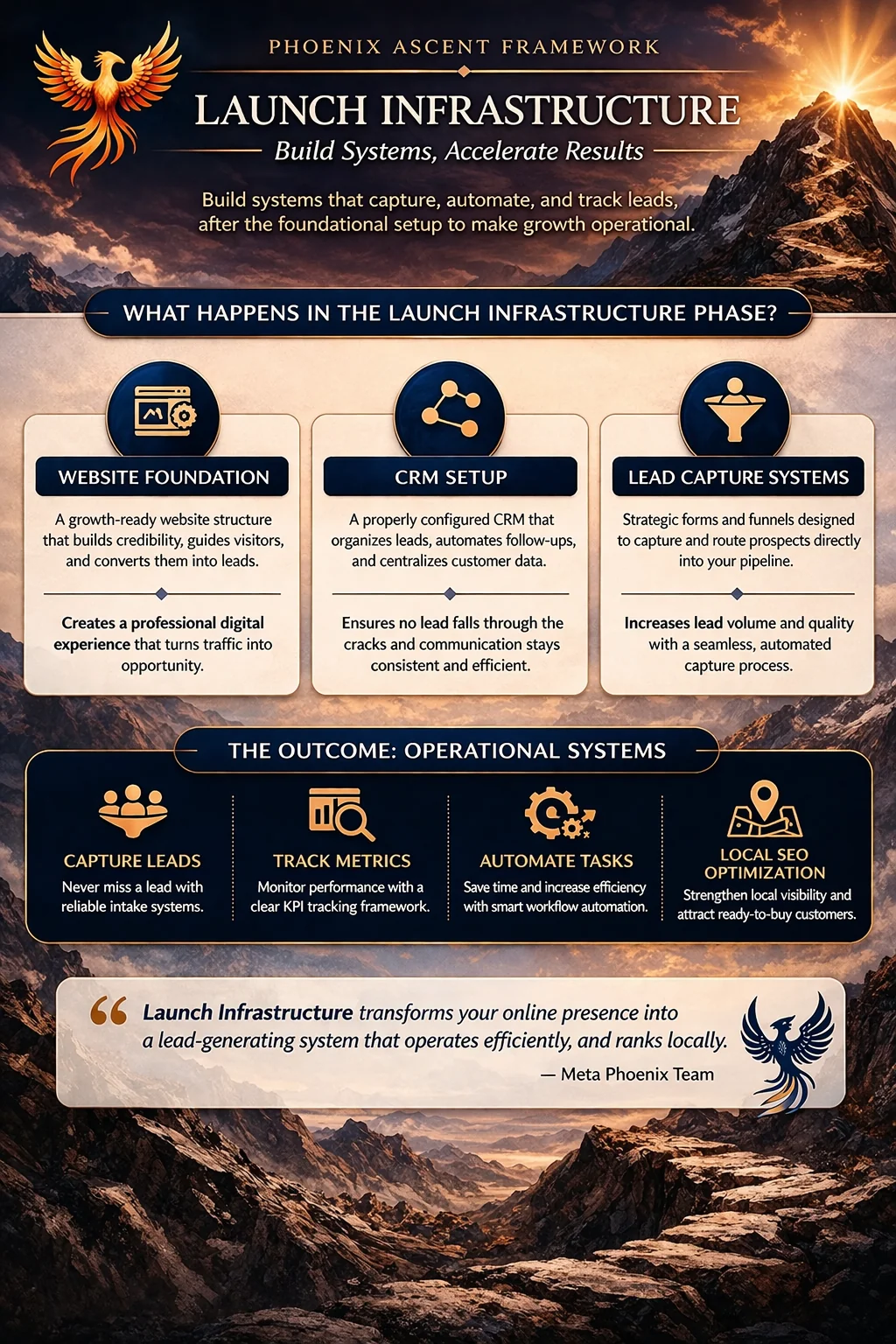
Stage 2 is where your multimedia and content marketing strategy starts connecting to your operations. You build the systems that capture, track, and nurture the leads your content generates.
Without this infrastructure, great content produces engagement but not revenue. With it, every piece of content feeds into a system that converts.
- CRM setup and lead capture workflows
- Automation foundations for content distribution and follow-up
- KPI tracking so you can measure what your content is actually doing
- Pricing from $3,500 to $8,000
Stage 3: Foundation Growth (Best for Businesses Building Consistent Momentum)
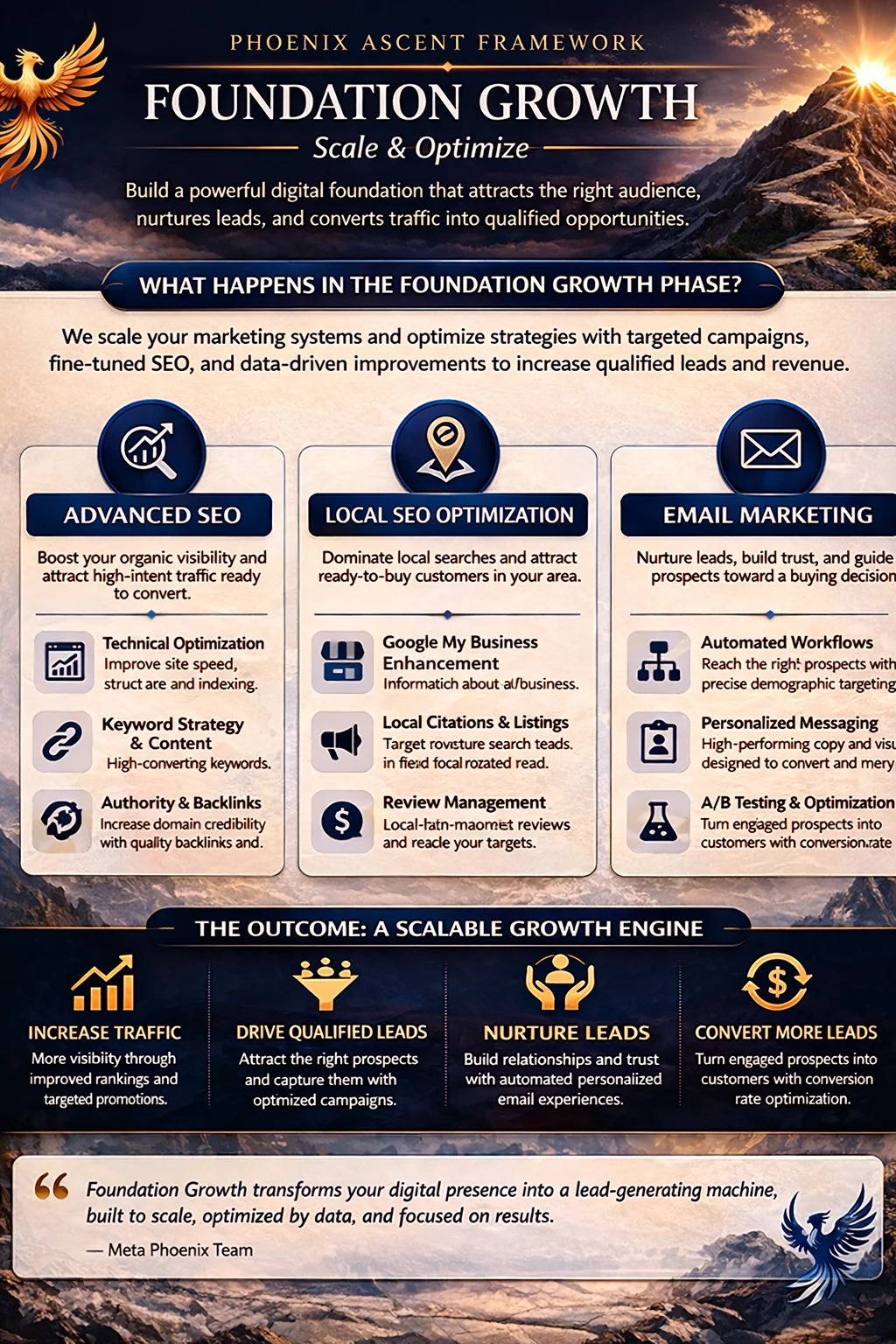
At Stage 3, you activate your content systems and start producing measurable results. This is where your multimedia and content marketing strategy becomes an engine, not just a set of activities.
We focus on ongoing refinement, email campaign execution, audience nurturing, and CRM optimization. The goal is consistency, because consistency is what produces scaleable growth.
- 90-day content and marketing direction with clear KPIs
- Email campaigns and lifecycle communications
- CRM optimization to maximise every lead your content generates
- At $1,500/month with a 90-day minimum
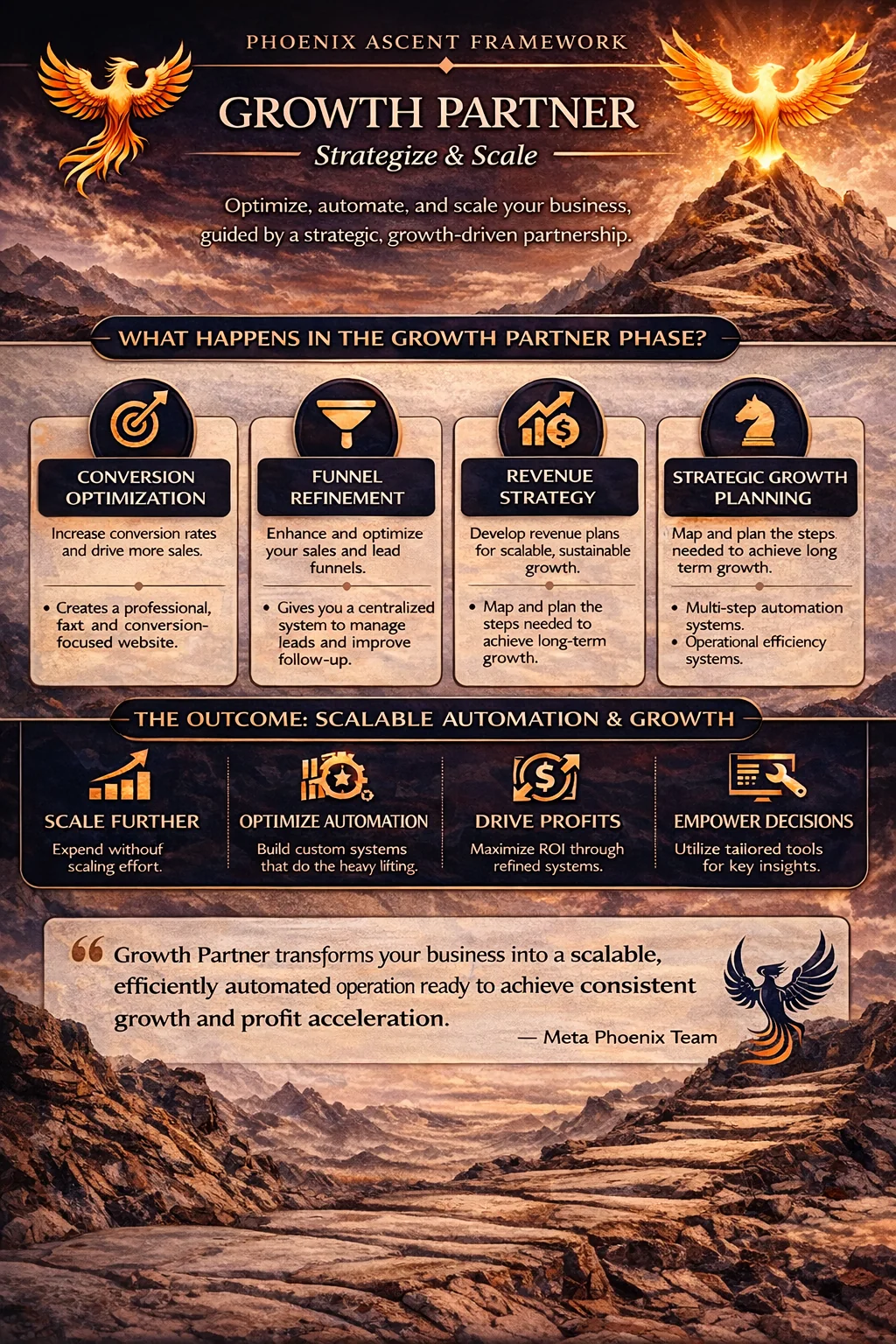
Stage 4: Growth Partner (Best for Businesses Ready to Scale)
Stage 4 is a long-term strategic partnership. Your multimedia and content marketing strategy at this stage is fully integrated with every part of your business: marketing, operations, systems, and revenue.
We embed as your growth partner to guide decisions, refine systems, and continuously optimize your content and marketing performance toward measurable targets.
- Strategic direction across marketing, content, and operations
- Ongoing website, CRM, and workflow optimization
- Custom dashboards and data tooling for full performance visibility
- From $2,000/month
How a Growth Partner Elevates Your Multimedia and Content Marketing Strategy
Most small business owners build content in isolation: a social post here, a blog article there, the occasional email. The problem is not effort. The problem is that these pieces do not connect to each other or to a clear business outcome.
A dedicated growth partner brings the strategic layer that ties everything together. They align your content calendar to your sales cycle, your video production to your conversion goals, and your distribution plan to where your audience actually spends time.
“The key isn’t doing more. It’s choosing the right next step. Every small business is at a different point, and the Phoenix Ascent Framework is how we guide that path forward with clarity.”
If you are unsure whether a growth partner relationship is right for your stage, read our full guide on how to scale a small business with structure before making any decisions.
Building Scaleable Growth Through Structured Content Systems
The word “scaleable” gets used loosely in marketing. In practical terms, scaleable growth through a multimedia and content marketing strategy means your content system can produce more results without requiring proportionally more resources.
This happens when you:
- Document your strategy so every team member or partner works from the same playbook
- Repurpose content systematically so a single video becomes a short clip, a quote card, an email, and a blog post
- Automate distribution so content reaches the right audience at the right time without manual effort
- Measure performance against revenue so you know what to produce more of and what to cut
Businesses that follow this model consistently outperform those that treat content as a creative activity rather than a growth system. The four-stage growth path we use is built entirely around this principle.
Did You Know?
49% of businesses report that revenue grows significantly faster when using video content compared to those who don’t. Multimedia is not just a marketing tactic, it is a direct revenue accelerator.
Multimedia and Content Marketing Strategy: Channel-by-Channel Breakdown
Choosing the right channels is as important as choosing the right formats. Here is how we recommend small business owners prioritize their channel mix in 2026.
| Channel | Best Format | Best For Stage | Key Metric |
|---|---|---|---|
| Website | Video + Written | All Stages | Conversion Rate |
| Video Thumbnail + Copy | Stage 3-4 | Click-Through Rate | |
| Social Media | Short-Form Video | Stage 2-4 | Engagement Rate |
| Podcast | Long-Form Audio | Stage 3-4 | Brand Recall |
| Landing Pages | Demo Video | Stage 2-4 | Lead Capture Rate |
| Interactive Tools | Quiz / Calculator | Stage 3-4 | Lead Quality Score |
Common Mistakes That Kill a Multimedia and Content Marketing Strategy
We have worked with enough small business owners to know where content strategies most often break down. Avoiding these mistakes will put you ahead of the majority of your competitors.
- No documented plan: Without documentation, your strategy lives in your head and dies when priorities shift.
- Producing without distributing: Creating content is only half the work. Without a distribution system, the best content never reaches its audience.
- Measuring vanity metrics: Likes and views do not pay the bills. Your multimedia and content marketing strategy needs to track leads, conversions, and revenue.
- Ignoring content repurposing: Every piece of content should have at least three uses. Producing once and posting once is a waste of creative and financial resources.
- Skipping the infrastructure stage: Building content before your CRM, automation, and capture systems are in place means sending traffic to a leaking bucket.
If any of these resonate, the most productive next step is a Growth Assessment to identify exactly where your current strategy is losing momentum.
Related Articles

How to Scale a Small Business
Practical steps for building the systems and infrastructure that take a small business from surviving to scaling.

What Is a Growth Partner?
Learn how a growth partner differs from a consultant or agency, and why small businesses need one for scalable, structured growth.
Ready to Build a Content Strategy That Drives Revenue?
Start with a growth assessment. It’s a conversation about where your business is today and what a structured multimedia strategy can do for your growth.