
If you’re searching for an ultimate guide to B2B lead generation for beginners, here’s a number that should grab your attention immediately: 78% of B2B customers buy from the first company that responds to their inquiry, regardless of price or brand recognition. That one fact tells you everything you need to know about where most small business owners are leaving money on the table, and why having a structured lead generation system is not optional.
Key Takeaways
| Question | Answer |
|---|---|
| What is B2B lead generation? | It is the process of identifying and attracting other businesses that may want to buy your product or service, then moving them toward a sales conversation. |
| Where should a beginner start? | Start with a clear digital presence, a defined target customer, and a basic system for capturing and following up with inquiries. |
| What is the biggest mistake beginners make? | Using tactics without a system. Posting on LinkedIn or running ads without a lead capture flow or follow-up process produces almost no results. |
| How long does it take to see results? | With a proper foundation in place, most small businesses begin generating consistent leads within 60 to 90 days of activating structured systems. |
| Do I need a sales team to do B2B lead generation? | No. Many small businesses generate and close B2B leads using automated systems, strong content, and a simple CRM before they ever hire a salesperson. |
| What role does a growth partner play? | A growth partner works alongside your business to build, activate, and optimize your lead generation systems over time, rather than handing over a one-off deliverable. |
| Is B2B lead generation different for small businesses? | Yes. Small businesses need efficient, low-cost systems that produce consistent output without a large team. Structure and speed matter more than budget size. |
What Is B2B Lead Generation? (Your Starting Point as a Beginner)
B2B lead generation is the process of attracting, capturing, and nurturing potential business clients until they are ready to buy from you.
Unlike selling directly to consumers, B2B buying cycles are longer, involve more decision-makers, and require more trust before a deal closes. That means your system needs to do more than generate interest; it needs to build credibility over time.
For a small business, this might feel overwhelming. The good news is that you don’t need a large team or a massive advertising budget to make it work. You need the right structure.

Think of B2B lead generation in three core stages:
- Attract: Getting the right businesses to notice you through your website, content, or outreach
- Capture: Converting that attention into a contact, form submission, or booking
- Nurture: Following up in a way that builds trust and moves prospects toward a decision
Most beginners focus almost entirely on the “attract” stage and wonder why nothing converts. This guide covers all three.
Why B2B Lead Generation Matters for Small Business Success in 2026
In 2026, B2B buyers complete approximately 70% of their purchasing journey independently before ever contacting a vendor. Your website, your content, and your digital presence are doing the bulk of the selling before you ever get on a call.
This is especially important for a small business that doesn’t have a dedicated sales team. If your digital presence is weak or your lead capture is broken, prospects will simply move on to a competitor who made it easier to engage.
B2B lead generation is also the foundation of scaleable growth. You cannot scale a business that relies entirely on referrals or word of mouth. Those channels are inconsistent and impossible to predict. A structured lead generation system gives you a repeatable, measurable way to bring in new business.
“You cannot scale what you cannot measure. B2B lead generation gives your business a consistent, trackable engine for new client acquisition.”
The Ultimate Guide to B2B Lead Generation for Beginners: Building Your Foundation First
Before you run a single ad or send a single cold email, you need a foundation. This is the step most beginners skip, and it’s the reason most beginner lead generation efforts produce nothing.
Your foundation includes three non-negotiable elements:
- A clear website with a defined value proposition: Visitors need to understand within seconds what you do, who you serve, and what they should do next.
- A lead capture mechanism: This could be a contact form, a booking link, a downloadable resource, or a live chat. Without this, traffic has nowhere to go.
- A follow-up system: This could be as simple as a CRM that alerts you when someone submits a form, combined with an automated acknowledgment email.

The Phoenix Ascent Framework, developed by Meta Phoenix, describes this as the “Digital Launch” stage, the structured starting point where every growth journey begins.
Their Digital Launch service (starting at $1,500) covers exactly this: a professional website build, mobile optimization, core page structure, and a basic lead capture setup. It gives beginners a solid, professional starting point without overcomplicating the process.
If you want a deeper understanding of how to build this kind of foundation step by step, the guide on how to scale a small business is worth reading before you do anything else.
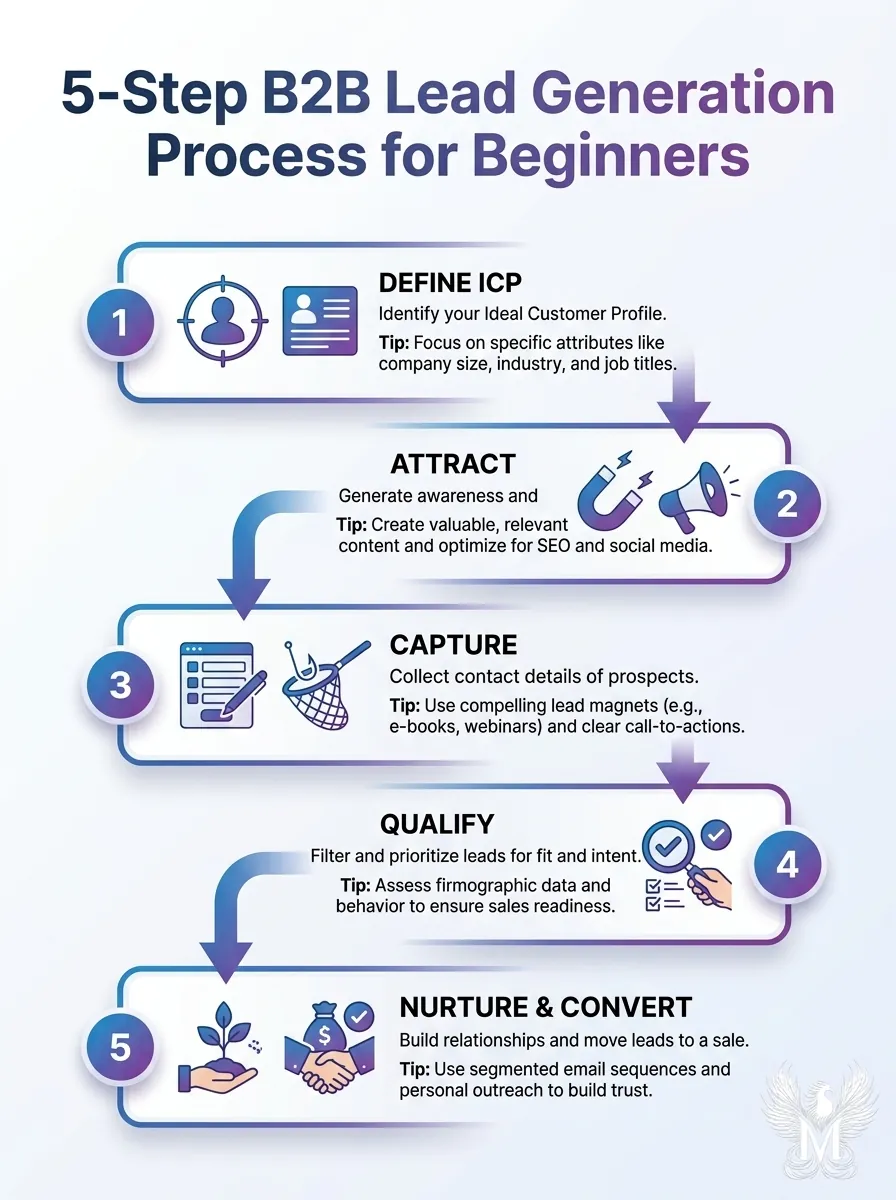
A concise visual guide outlining the 5-step B2B lead generation process for beginners. Use this infographic to plan, execute, and optimize your outreach.
Best B2B Lead Generation Channels for Beginners (And Which to Prioritize)
One of the most common questions in any ultimate guide to B2B lead generation for beginners is: where do I actually find leads?
Here is a breakdown of the most effective channels, ranked by accessibility for businesses just getting started:
| Channel | Best For | Beginner Difficulty | Lead Quality |
|---|---|---|---|
| Website + Lead Capture | All businesses | Low | High (inbound intent) |
| LinkedIn Outreach | Service businesses | Low-Medium | Medium-High |
| Email Campaigns | Warm or existing audiences | Medium | Medium |
| Content and Articles | Long-term brand building | Medium | Very High (self-qualified) |
| Paid Ads (Google/LinkedIn) | Businesses with budget | High | Varies |
| Referral Programs | Established businesses | Low | Very High |
For most beginners, we recommend starting with your website and a LinkedIn presence. These two channels require the least financial investment while delivering qualified traffic and inbound intent.
Once those are active and capturing leads consistently, you layer in email and content. Paid advertising is best added later, once you know your offer converts.
Did You Know?
Tightly aligned sales and marketing teams experience up to 208% higher revenue growth than those that operate in silos.
How to Build a B2B Lead Generation System: The Infrastructure Behind Scaleable Growth
Tactics get attention. Systems generate revenue. This is the critical distinction every beginner needs to understand when working through any ultimate guide to B2B lead generation for beginners.
A lead generation system is the infrastructure that connects your marketing activities to your sales pipeline. It includes:
- CRM (Customer Relationship Management) software: Tracks every lead from first contact to close
- Automated follow-up sequences: Responds to inquiries immediately and nurtures leads over time
- Pipeline stages: Clear definitions of where each lead sits and what the next action is
- Lead scoring: A simple system to prioritize leads most likely to convert
- Performance dashboards: Visibility into which channels are producing and which are not
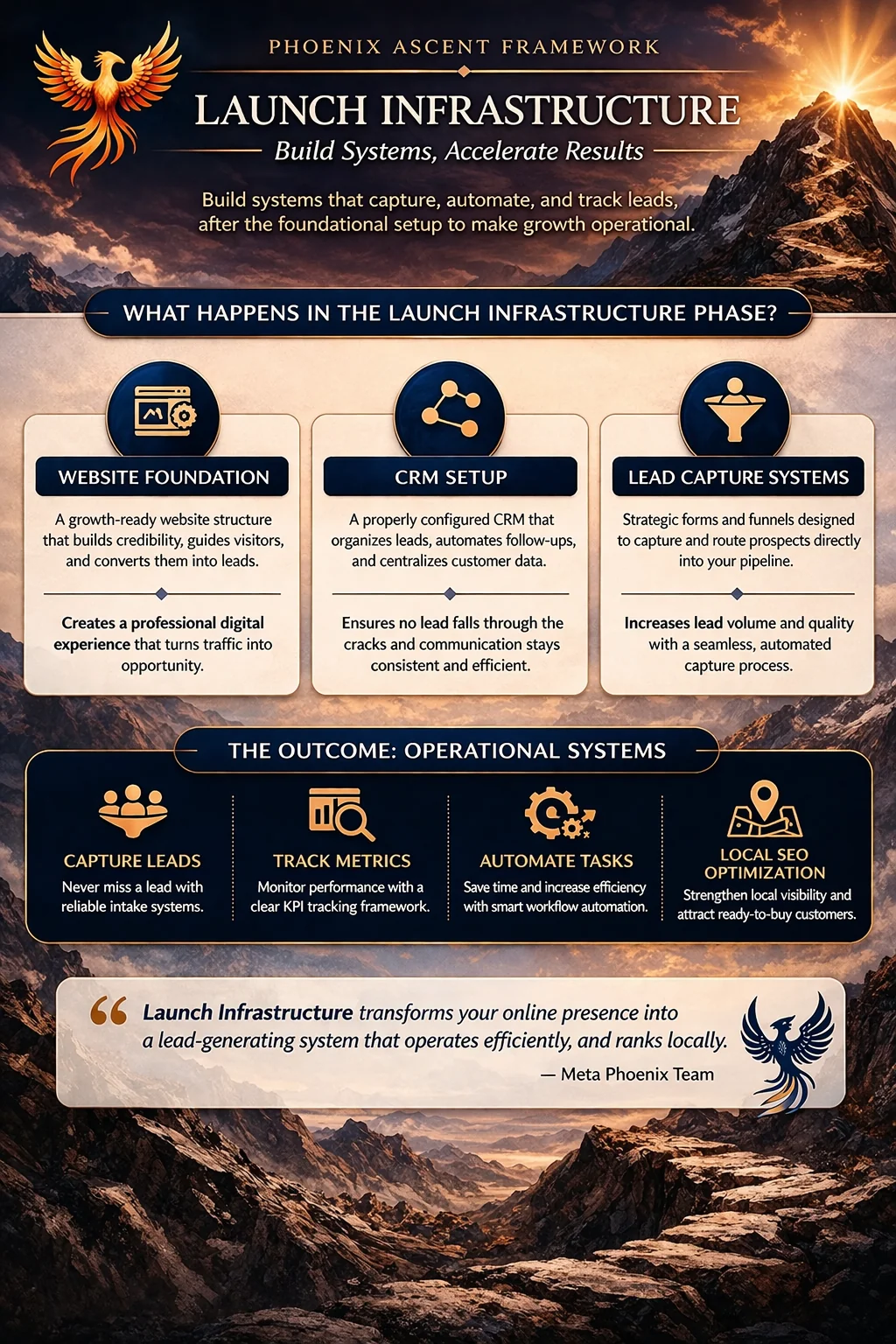
Meta Phoenix describes this as the “Launch Infrastructure” stage, the second phase of the Phoenix Ascent Framework. At $3,500 to $8,000, it connects your website, CRM, and workflows into a single structured system. This is where a small business moves from having a presence to having a performance engine.
Without this infrastructure, every lead generation activity you do is working in isolation. You might get an inquiry, but if there’s no automated response, no CRM entry, and no follow-up reminder, that lead disappears.
This is also where scaleable growth becomes possible. When your system is connected, you can start measuring cost per lead, conversion rates, and pipeline velocity. Those numbers tell you exactly where to invest next.
The Ultimate Guide to B2B Lead Generation for Beginners: What to Do With Leads Once You Have Them
Capturing a lead is only half the job. What you do in the first few minutes and days after a lead comes in determines whether you win the business or lose it to a faster competitor.
Here is a simple beginner-friendly lead follow-up process:
- Immediate auto-response (within 60 seconds): Send an automated acknowledgment email that confirms you received their inquiry and sets expectations for next steps.
- Personal follow-up (within 1 hour): Have a real person (or a well-scripted automation) follow up with a specific next step, such as a link to book a call.
- Nurture sequence (Days 2-14): Send 3 to 5 emails that provide genuine value, answer common objections, and move the prospect toward a buying decision.
- Manual touchpoint (Day 7): A direct, personalized check-in from you or your team. This is where deals are often won.
- Long-term nurture (Month 2 onwards): Keep non-converted leads in a low-frequency sequence until they are ready to buy.
The key principle here is speed. 95% of the time, the winning vendor is one of the companies on the buyer’s “Day One” shortlist, formed before formal evaluation even begins. That shortlist is built on who showed up first, responded fastest, and built awareness before the lead was ready to buy.
Did You Know?
Leads contacted within 5 minutes are 21 times more likely to be qualified than those contacted after 30 minutes.
How a Growth Partner Drives Consistent B2B Lead Generation for Small Businesses
Many small business owners try to manage lead generation entirely on their own. The result is usually inconsistent effort, missed follow-ups, and a pipeline that looks healthy one month and empty the next.
This is where working with a growth partner changes everything.
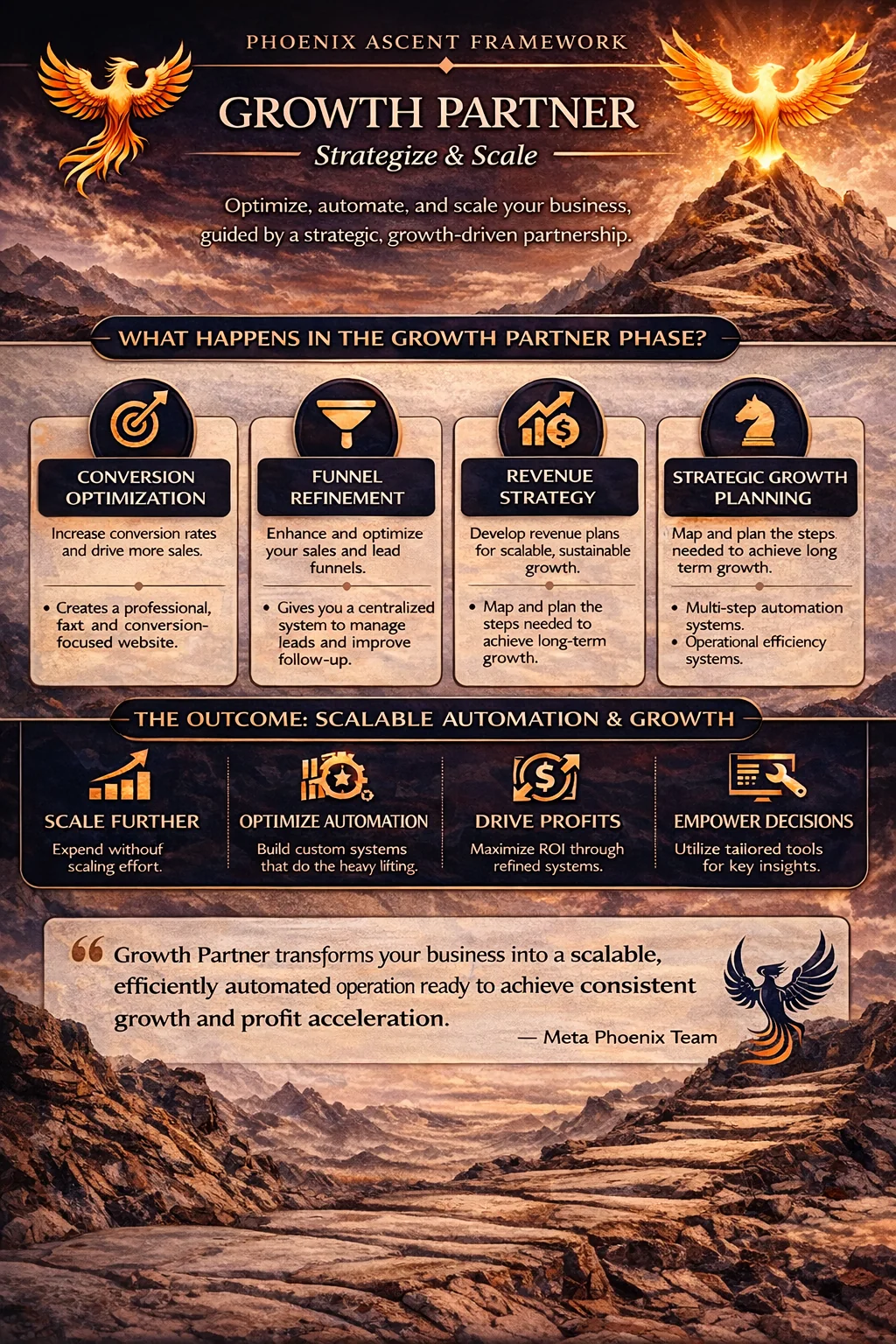
A growth partner is not a consultant who gives you a report and disappears. They are embedded in your business, building and optimizing the systems that generate leads, tracking performance through dashboards, and making strategic adjustments every month.
Meta Phoenix’s Growth Partner engagement (starting at $2,000/month) includes ongoing strategic direction, custom dashboards, workflow automation, and cross-functional alignment across marketing and operations. It is designed specifically for small businesses that need consistent growth without having to hire a full in-house team.
For beginners, the idea of a growth partner might feel like a later-stage investment. But understanding how the model works from the beginning shapes the systems you build now. You can read a detailed breakdown of what this relationship actually looks like in practice in the article on what a growth partner actually does for small business growth.
Scaleable Growth: Moving from Lead Generation Beginner to Consistent Pipeline
Scaleable growth in B2B lead generation happens when your system generates predictable output, meaning you know that a certain level of activity produces a certain number of leads and a certain number of clients, every month.
Getting there as a beginner happens in stages:
- Stage 1 (Months 1-2): Foundation in place. Website live, lead capture active, basic CRM set up.
- Stage 2 (Months 2-4): First leads captured, follow-up process activated, initial data collected.
- Stage 3 (Months 4-6): Performance data reviewed, channels optimized, conversion rates improving.
- Stage 4 (Month 6+): System running consistently, results predictable, growth compounding.
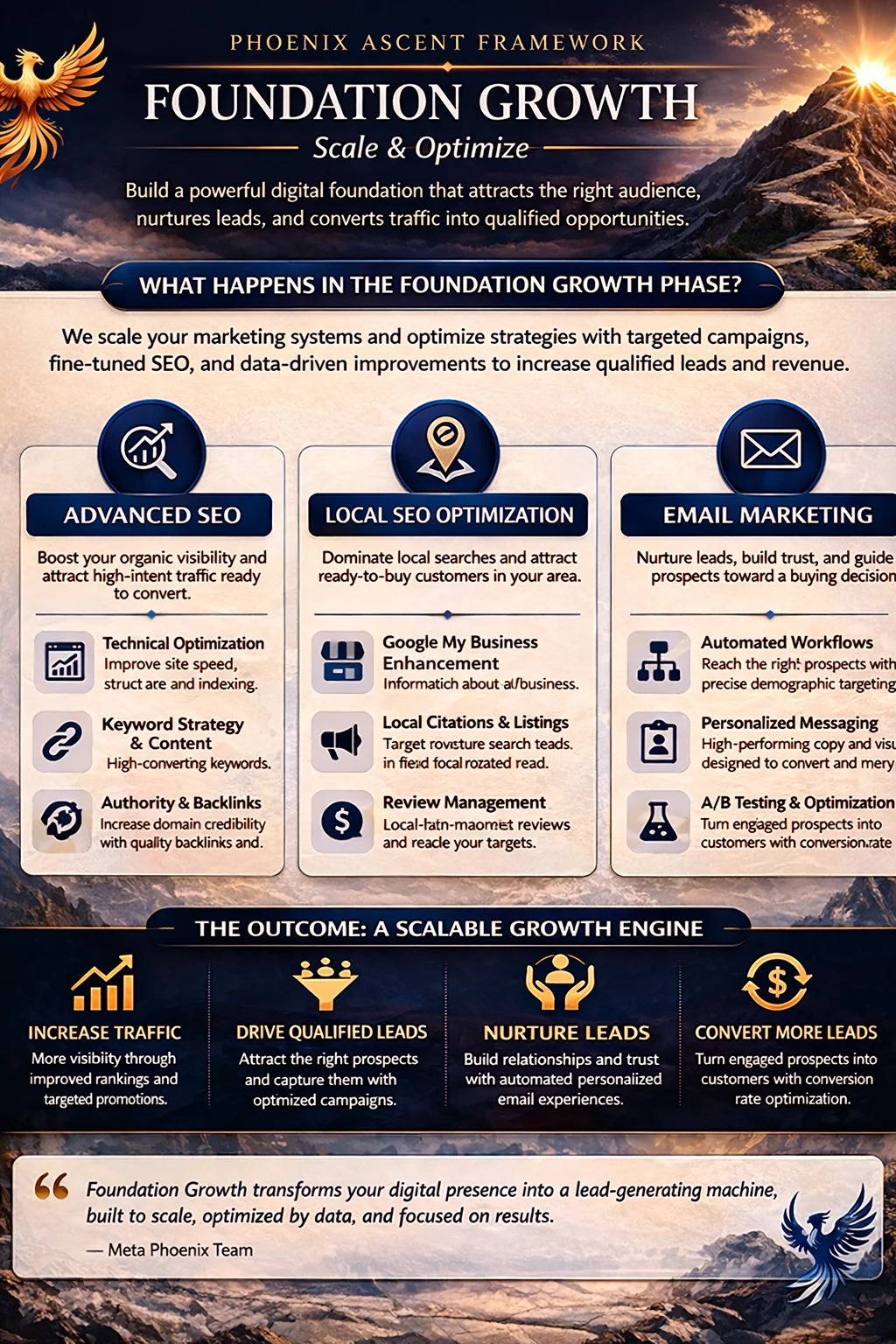
Meta Phoenix’s Foundation Growth stage (at $1,500/month) maps directly to stages 2 and 3 above. It provides a 90-day structured engagement to activate systems, run weekly reviews, and build the operational rhythm that creates consistent output.
Most small businesses skip straight to tactics and miss the foundation entirely. The result is sporadic leads with no ability to predict or scale. Building the system first, even if it takes a few months, is what separates businesses with scaleable growth from businesses that stay stuck in the feast-or-famine cycle.
Common B2B Lead Generation Mistakes Beginners Make (And How to Avoid Them)
No ultimate guide to B2B lead generation for beginners would be complete without an honest look at where most people go wrong.
Here are the most common mistakes and how to avoid them:
- Chasing tactics before building infrastructure: Running ads or posting content before you have a lead capture system means you’re generating interest with nowhere for it to go.
- Targeting too broadly: “Any business that needs our service” is not a target market. Define a specific industry, size, and pain point before you do anything else.
- Following up too slowly: Even waiting 24 hours to respond to an inquiry dramatically reduces your chances of converting it. Automate your initial response immediately.
- Ignoring the nurture phase: Most B2B leads are not ready to buy immediately. A business that only follows up once loses to the competitor that stays in front of the prospect for months.
- Not measuring results: If you don’t know which channel your leads came from, which messages converted, or what your close rate is, you have no basis for improvement.
- Copying B2C tactics: B2B buyers respond to logic, ROI, and risk reduction, not urgency and emotional appeals. Adjust your messaging accordingly.
Avoiding these mistakes from the start puts any small business years ahead of competitors who learn these lessons the hard way.
The Phoenix Ascent Framework: A Structured Path to B2B Lead Generation Success
One of the most useful frameworks we’ve come across for beginners approaching B2B lead generation is the Phoenix Ascent Framework, built by Meta Phoenix specifically for small businesses that want structured, measurable growth.

The framework moves businesses through four distinct stages:
- Digital Launch ($1,500 to $3,000): Establish a clear digital presence with a live website, mobile optimization, and a working lead capture setup.
- Launch Infrastructure ($3,500 to $8,000): Connect your website, CRM, and workflows into one integrated system with clear pipeline visibility.
- Foundation Growth ($1,500/month): Activate and refine your systems with 90-day structured engagement, weekly execution reviews, and momentum building.
- Growth Partner ($2,000/month+): Long-term strategic partnership with dashboards, automation, and continuous optimization for scaleable growth.
What makes this framework particularly relevant to B2B lead generation beginners is that it addresses the whole system, not just isolated tactics. Each stage builds on the previous one, creating a compounding effect over time.
You can explore the full framework and find your starting point on the business growth stages page.
Conclusion: Your Ultimate Guide to B2B Lead Generation for Beginners Starts with Structure
The ultimate guide to B2B lead generation for beginners comes down to one core principle: build the system before you run the tactics.
Most beginners waste months chasing channels that produce no results because they haven’t laid the foundation. A clear website, a working lead capture mechanism, a connected CRM, and a follow-up process are the non-negotiables. Everything else is layered on top of that base.
For a small business looking to achieve scaleable growth, the path is not complicated, but it is structured. Know your target client. Build your digital foundation. Connect your systems. Activate your lead generation channels. Measure, refine, and compound.
If you want support doing this with a structured framework rather than guessing as you go, working with a growth partner gives you the expertise, accountability, and systems to accelerate the process significantly. The businesses that grow consistently in 2026 are the ones that treat lead generation as a system, not a series of one-off experiments.
Start where you are. Build what you need. Move forward with structure.
Frequently Asked Questions
The best strategy for beginners is to start with inbound lead generation: build a clear website, set up lead capture forms, and optimize your LinkedIn profile to attract the right businesses. Once those basics are generating consistent traffic and inquiries, you layer in email nurture sequences and content to accelerate the process. Trying to run multiple channels before your foundation is solid leads to scattered effort and poor results.
Most small businesses with a properly built foundation start seeing consistent leads within 60 to 90 days of activating their lead generation systems. The first 30 days are typically spent building and connecting infrastructure, including your website, CRM, and follow-up sequences. Results compound over time as your content builds authority and your systems improve based on performance data.
Absolutely. B2B lead generation is the foundation of any small business that wants predictable, scaleable growth instead of depending on referrals or word of mouth. In 2026, with buyers completing most of their research independently before contacting vendors, having a structured system to capture and nurture that interest is not optional. The businesses that generate consistent revenue are the ones that treat lead generation as a system, not an afterthought.
At a minimum, beginners need a professional website with a lead capture form, a CRM to manage and track leads, and an email platform for follow-up sequences. Tools like HubSpot (free tier), Mailchimp, and LinkedIn Sales Navigator are common starting points for small businesses. The specific tools matter less than having them connected and working together as a unified system.
A marketing agency typically executes specific deliverables like ads or content and hands them over, whereas a growth partner is embedded in your business long-term, building and optimizing the full system that drives lead generation and revenue. For small businesses working through B2B lead generation for the first time, a growth partner provides strategic alignment across marketing, operations, and sales rather than isolated campaign management. This integrated approach produces more consistent and measurable results.
Use a simple qualification framework based on four questions: Does this business fit my target profile? Do they have the budget for my service? Do they have a clear need I can solve? And do they have the authority or access to a decision-maker? Building these questions into your intake form or your first follow-up message allows you to quickly identify high-priority leads and avoid spending time on prospects that will never convert.
Yes, and for most beginners we recommend starting without paid ads entirely. Inbound content, LinkedIn outreach, a well-optimized website, and a strong email follow-up process can generate consistent B2B leads at very low cost. Paid advertising works best when you already know your offer converts and you want to accelerate volume, not as a way to test whether your system works. Build the foundation first, then amplify with budget when you have data to guide it.